Jackson Elite Roofing brings more than 20 years of experience to roofing in Burlington, and a large share of the work in this city happens on houses that share a wall with the house next door. A twin or a row house is not simply a smaller detached home, because its roof keeps going past the point where the deed stops and someone else’s ownership begins.
That single fact changes nearly every decision on the job. Where the new roof ends, how it meets the neighbor’s older covering, who is responsible when water appears in a bedroom ceiling, and what the state code asks of the work all depend on the house being attached. We plan for each of those questions before a single shingle comes off.
Our approach starts with a straight answer rather than a sales pitch. If the roof can be repaired, we say so before replacement is ever mentioned, and every leak call includes time in the attic as well as on the roof, so the real entry point is found before anything is priced. On an attached house, that attic look often settles which side of the seam the water came from.
Twins and Row Houses in Burlington City
A Third of the City Shares a Wall
Attached houses are not a niche housing type here. The census’s 2024 five-year estimates count 1,397 one-unit attached houses in Burlington City, 33.2 percent of its 4,208 housing units. Of the occupied ones, 793 are owned by the people living in them and 404 are rented, so both owners and landlords end up making roof decisions on shared buildings.
That means a roofer working in town meets twins and rows constantly, and habits that work on a detached ranch do not carry over cleanly. Ridge lines run across property lines, a gutter may run unbroken along several houses, and the owner who calls us is rarely the only person with a stake in the roof overhead.
From an 1885 End of Row to a 1986 Twin
The type spans more than a century of building. One recent listing on Barclay Street described a three-story end-of-row Colonial built in 1885, and another on Saint Mary Street described a 1986 twin with a straight-thru layout and a pitched roof less than five years old.
Both were listed with no homeowners association, and that detail matters more than it looks. In a townhouse community, an association often holds the roof or sets the rules for replacing it, and we check those documents before estimating. On a Burlington City twin or row with no association, each owner deals with the roof directly, and so does each neighbor.
Older Stock, More Layers of History
Age compounds the shared-roof question. The same census estimates place 1,720 of the city’s 4,208 units in buildings from 1939 or earlier, so many attached roofs have been patched, overlaid and re-flashed by different owners on different schedules for decades.
When we open one of these roofs, we expect mismatched underlayment, old flashing buried under newer material, and decking that has already been through more than one tear-off. Any damaged decking is photographed and shown to the owner before it is replaced, at the per-sheet price written into the contract, so a surprise on an old roof never turns into an open-ended bill.
Looking for roofing closer to South Amboy? See Roofing in South Amboy.
One Roof, Two or More Owners
Where Your Roof Ends
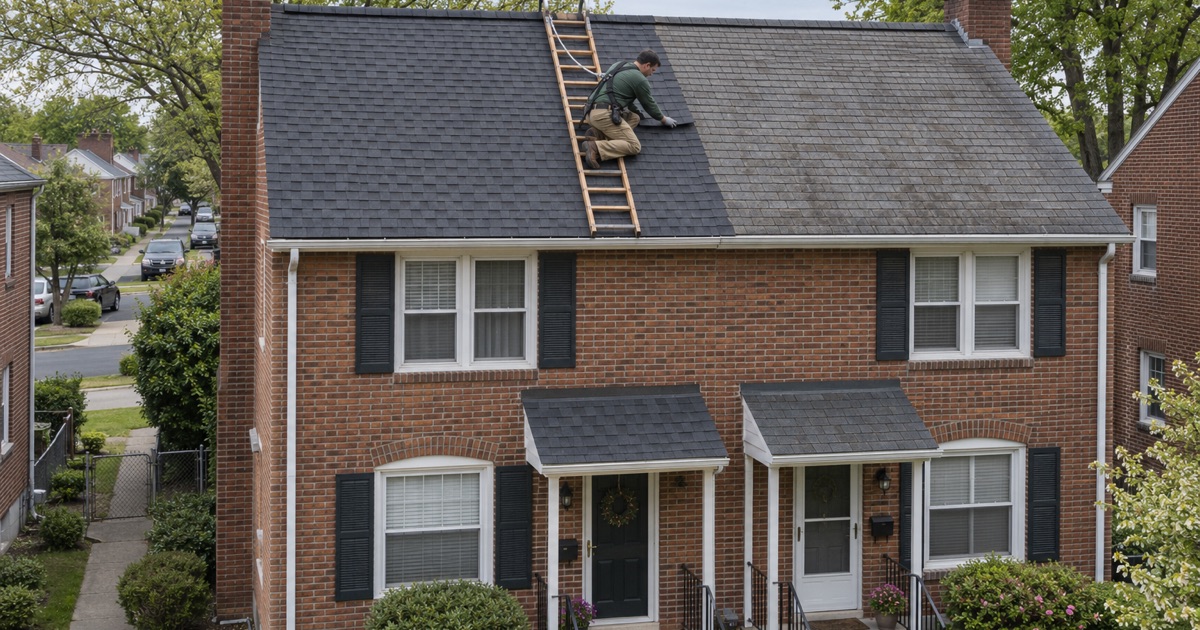
On a twin, the roof usually reads as one shape from the street, yet each owner holds a slice of it. On a row, the middle houses hold slices bounded on both sides, while the end-of-row owner controls one outside edge and shares the other with the house next door.
Before we price anything, we work out exactly where your slice begins and ends on the roof itself. That line usually follows the party wall below, but we confirm it on site, because it is where the new work must stop and where the most careful detailing on the whole job will happen.
Stopping a New Roof at the Property Line
A re-roof on an attached house rarely gets the luxury of a clean edge. The new covering runs up to the property line and then has to meet the neighbor’s roof, which may be older, a different material or a different color. That tie-in is where a re-roof on a twin or row succeeds or fails.
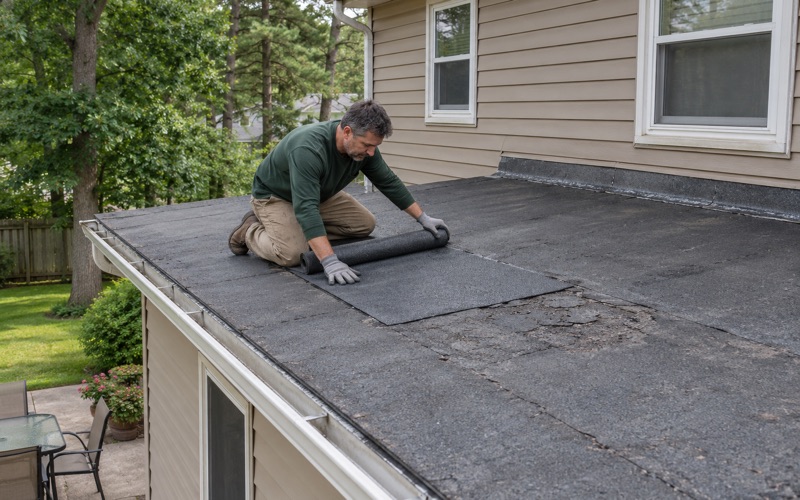
At the seam, the new underlayment, the new shingles or membrane, and the flashing all have to lap over or under the neighbor’s materials so water runs off rather than in. We lay a self-adhering ice and water barrier across the joint and detail the transition so it keeps shedding water as the neighbor’s side continues to age.
Talking With the Neighbor Before the Tear-Off
We cannot reach the tie-in without working right at the neighbor’s edge, so we suggest the owner talk with them before the job starts. A short conversation about the schedule, the noise, and the few inches of their roof our crew may need to lift or seal is far better than a surprise on tear-off morning.
Some owners go further and coordinate so both halves of a twin are re-roofed at once, which removes the mismatched seam entirely. Whether that makes sense depends on the age of the neighbor’s roof and on both households’ budgets, and we will price either approach so everyone can see the difference line by line.
Leaks at the Seam Between Neighbors
Why Shared-Wall Leaks Are Hard to Read
Water does not respect a deed line. A leak at the seam between two attached houses can start on either side, travel along a rafter or the top of the party wall, and show up as a stain in the house that did nothing wrong.
That is why we never diagnose from the stain alone. We go into the attic where access allows, trace the wet wood and staining back toward its source, and match that to what we see on the roof. Only then do we tell the owner whether the problem sits on their side, the neighbor’s side, or right on the joint between them.
Flashing at the Party Wall and the Chimney
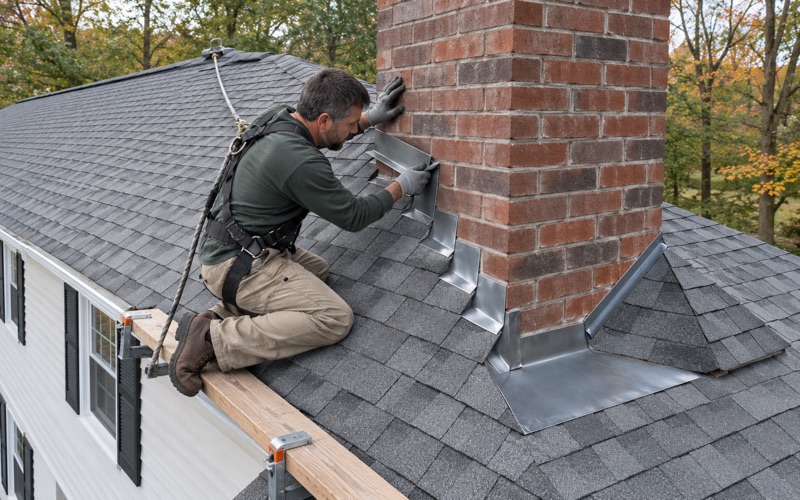
Some attached houses carry a raised parapet or a shared chimney on the party wall line, and both are common entry points. Step flashing and counter flashing set into a reglet keep water out where a roof meets masonry, and aging flashing is often the first thing to fail.
When we replace a roof, the step, counter and chimney flashing is replaced with it rather than bent back over new material. On a shared chimney that work sits right at the property line, so we explain exactly which flashing pieces belong to your side and how they lap onto the neighbor’s.
Repair First, When Repair Is Honest
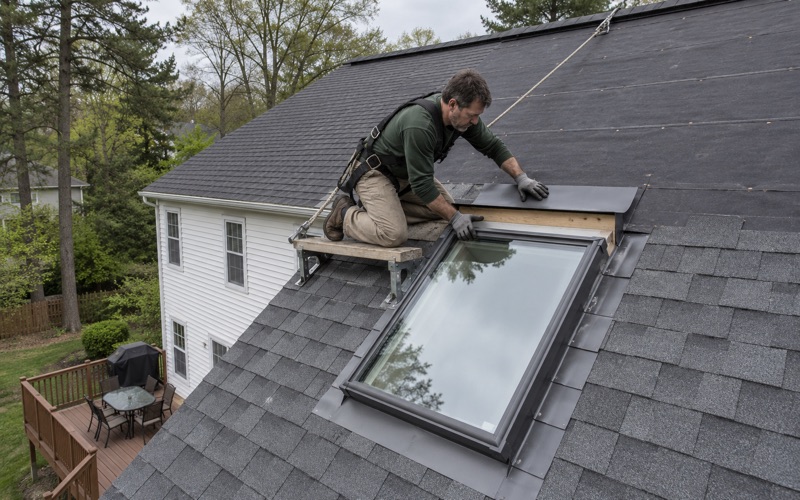
A seam leak does not always mean a new roof. Often the fix is a resealed or rebuilt transition, a new run of flashing, or a replaced pipe boot near the line. If a repair will hold, we say so plainly and quote it as a repair, not as the first step toward a bigger sale.
When the roof itself is at the end of its life, we explain why a patch at the seam would only move the problem a few feet. Either way, the written scope lists tear-off, decking, underlayment, flashing, ventilation and gutters on separate lines, so you can compare our number with anyone else’s item by item.
Re-Roofing an Attached House Is Permit Work
Why the Exemption Does Not Reach a Twin or Row
New Jersey treats replacing the roof covering on a detached one- or two-family dwelling as ordinary maintenance under N.J.A.C. 5:23-2.7, with no permit needed. The word detached does real work in that rule. A one-unit attached house falls outside it, so re-roofing a twin or a row house in Burlington City is permit work.
Owners are sometimes surprised by that, especially if a relative with a detached house elsewhere re-roofed without any paperwork. We build the permit into the schedule from the start and handle the application as part of the job, so the work is inspected and recorded rather than left as a question for a future buyer.
Planning the Job Around Inspections
Permit work means inspections, and on an attached roof the inspector will look closely at the same places we do: the tie-in at the property line, the flashing at walls and chimneys, and the ventilation. We sequence the tear-off and dry-in so the roof is never left open while waiting for a visit.
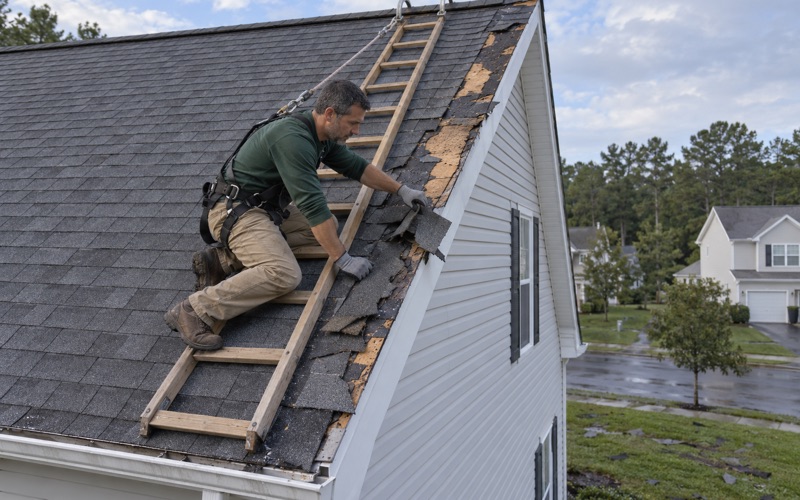
The state’s rehabilitation subcode also calls for a tear-off once a roof already carries two or more layers, and older city roofs sometimes hide a second layer under the current one. When we find that during the estimate, a full tear-off down to the decking becomes the plan, and we put it in writing before the contract is signed.
Ventilation, Gutters and Cleanup
Rows and twins often have short, shallow attics with little room for air to move, and a roof that cannot breathe ages from underneath. We check the ventilation on every replacement, balancing ridge vent exhaust against soffit intake where the structure allows it.
Gutters on an attached block may run past several houses, so we size and pitch yours to drain your section without dumping water onto the neighbor’s. Contracts follow New Jersey’s home improvement rules, including the three-day cancellation notice, and the yard, walk and gutters are cleaned at the end of every work day with a magnet sweep for stray nails.
If you are selling a twin or row, we can also write a roof condition report you can hand to the buyer’s inspector. On an attached house, that report notes the condition of your side, the state of the tie-in at the property line, and the flashing along the party wall, which are the questions a careful buyer will ask first.
- 20+ Years in Business
- Free Written Estimates
- Attic Checked on Every Leak Call