Jackson Elite Roofing has more than 20 years of residential work behind it, and roofing in Cedar Glen Lakes asks a question most towns never raise before the ladder goes up: who is responsible for this roof? When a home sits inside a cooperative, a ceiling stain usually travels through an office before it ever reaches a contractor, and we plan our part around that order rather than against it.
That is why we read the association’s documents before writing any estimate in a community like this one. If the governing papers put the roof with the corporation, our role may be a second opinion, a written condition report, or nothing at all, and we will say so plainly. If the roof falls to the resident, we give a straight answer on whether a repair will hold before replacement ever comes up.
Most of what follows is practical: how a roof problem moves through the cooperative’s request system, what qualifies as urgent, why these particular buildings behave the way they do after five decades, and what a resident can write down and photograph while a request is waiting. None of it replaces the maintenance office. It is meant to help a resident reach that office with better information.
Six Hundred Work Requests a Month at Cedar Glen Lakes
What the President’s Message Said
In the October 2026 issue of Echoes of the Glen, Volume 31, Issue 10, the president of Cedar Glen Lakes, Inc. put the maintenance load plainly: “Our homes are 50 years old and are needing more repairs. We have an average of 600 work requests a month.” Garbage pickup was moved to once a week so that workers could be freed for the many jobs throughout the village.
That is a volume figure, not a complaint, and we read it that way. The same message noted that other communities do not take care of a lot of the repairs this one does, and that the board is trying not to burden residents with out-of-pocket costs. A roof issue enters a system that is busy precisely because it does a great deal of work.
Where a Roof Call Sits in That Volume
Six hundred requests covers everything from a sticking door to a dripping faucet, so a roof report lands among many other jobs. The maintenance staff sorts and schedules them, and a resident has no view of that sorting from the kitchen table. What a resident does control is how clearly the roof problem is described when it goes in.
A request that says “leak in the back bedroom” gives a crew less to work with than one that names the room, the wall, the time the drip started and whether it followed wind or steady rain. Clear detail helps whoever responds, whether that is the cooperative’s own crew or an outside roofer a resident brings in where the documents allow it.
Shares, Not Deeds
Residents of Cedar Glen Lakes own shares in the corporation and receive a stock certificate rather than owning the house itself, and stockholders share the cost of maintenance, property taxes and insurance, according to the community newsletter. That structure is why a roof question here begins with the paperwork and not with the shingles.
We have not read a governing document that says who replaces roofs in this community, so we never assume either way. Before we price anything, we ask to see the occupancy agreement or the rules and regulations that apply, and we check responsibility for the roof against them. If the answer points to the cooperative, we tell the resident so and stop there.
Looking for roofing closer to Holiday City-Berkeley? See Roofing Services in Holiday City-Berkeley.
When a Leak Goes Through the Maintenance Office
The Business Office and the Emergency Line
Cedar Glen Lakes, Inc. lists its address at 100 Michigan Avenue in Whiting, with a business office at 732-350-2223 and a separate emergency maintenance line at 732-350-2555. Those are the numbers the newsletter prints, and they are the first calls for a resident whose roof sits under the cooperative’s care.
We suggest keeping both numbers on the refrigerator rather than in a drawer. A roof problem rarely announces itself during office hours, and knowing which line to dial in the first ten minutes keeps water from spreading while someone searches for a phone list. It also keeps a true emergency off the routine pile.
What Counts as Urgent
Active water coming through a ceiling fixture, a sagging stain that keeps growing, or shingles and flashing torn loose and flapping in the wind are the kinds of conditions that belong on an emergency line rather than in a routine request. Water near wiring is a safety matter first and a roofing matter second.
A small brown ring that has not changed in a month, a single shingle lying on the lawn, or granules collecting at a downspout are real signs, but they are usually routine. Reporting them early is worthwhile. The cooperative decides how its own staff schedules that work, and we do not second-guess those decisions.
Where an Outside Roofer Fits
Where a resident’s documents put a repair in their own hands, or where they simply want an independent view, we go into the attic as well as onto the roof, so the water is traced to where it actually enters before anything is priced. Many ceiling stains sit several feet from the opening that caused them.
Our written scopes break out tear-off, decking, underlayment, flashing, ventilation and gutters on separate lines. That lets a resident, or the cooperative’s office, compare our numbers item by item against any other estimate. Every contract follows New Jersey’s home improvement rules, including the three-business-day cancellation notice.
Fifty-Year-Old Roofs on Attached and Two-Unit Buildings
A 1970s Housing Stock
The census numbers back up the president’s description. The 2024 American Community Survey counts 663 of the community’s 1,108 housing units, or 59.8 percent, as built between 1970 and 1979. Most roofs here sit on rafters and sheathing that are approaching half a century of age, whatever covering is on top today.
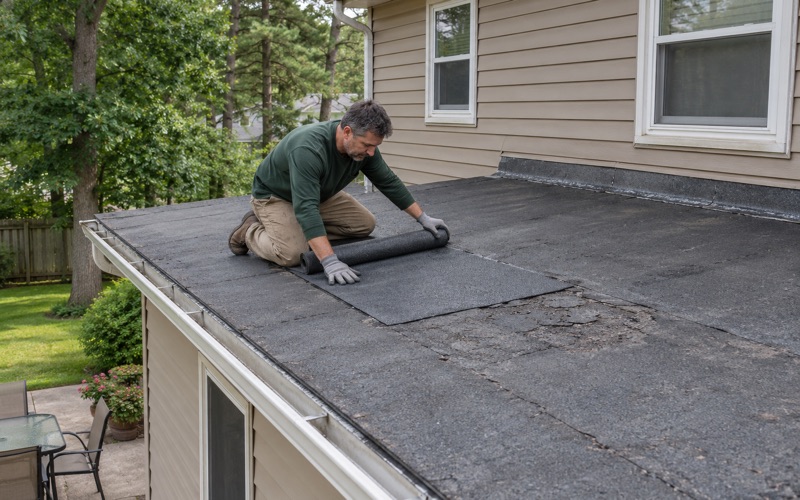
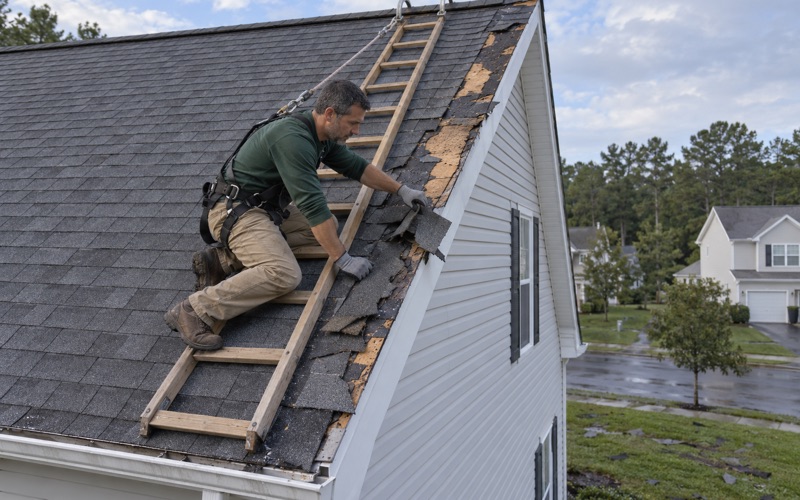
Roof coverings have been replaced over that span, sometimes more than once, but the framing, decking and many of the flashing details underneath are often original. When an old covering comes off, any damaged decking we find is photographed and shown to the owner before it is replaced, at a per-sheet price set in the contract.
Shared Walls and Shared Rooflines
About two-thirds of units are attached or sit in two-unit buildings: the survey counts 386 one-unit attached homes and 372 units in two-unit buildings, against 350 detached. On a shared roofline, water entering over one side can travel along the framing and show up in the home next door.
That makes the attic inspection matter more here than on a stand-alone house. We trace staining back along rafters and sheathing, and we check whether a valley or a wall flashing shared between two homes is involved. If the cause sits over a neighbor’s half, the resident needs to know that before anyone touches their side.
Flashing, Ventilation and Permits
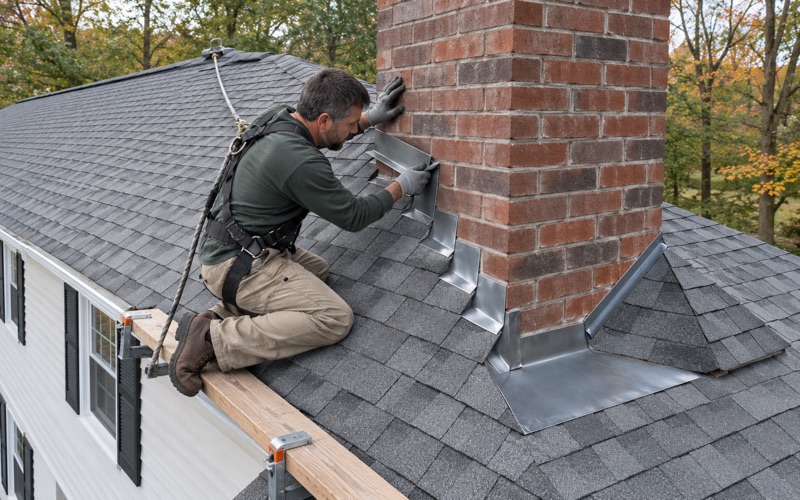
On any replacement we handle, step, counter and chimney flashing is replaced with the roof rather than reused under new material, and attic ventilation is checked, because a roof that cannot breathe ages from underneath. Older roofs often have soffit intake that was painted over or buried under insulation decades ago.
Permits are another place attached homes differ. New Jersey’s ordinary-maintenance rule for roof covering applies to detached one- and two-family dwellings, and one-unit attached homes fall outside it, so their re-roofing is permit work through Manchester Township. How the township classes a two-unit cooperative building under that rule is something we confirm case by case.
What a Resident Can Document While a Request Waits
Photographs With Dates
A phone camera is the best tool a resident has. Photograph the stain the day it appears, then again after each rain, from the same spot and with the same light on. A series of dated pictures shows whether a problem is active or settled, which helps whoever is deciding how to respond.
Outside, a photo from the ground of the affected roof slope, any loose shingles in the yard and the gutter above the problem room adds useful context. Nobody should climb a ladder to get it. Fall protection rules for roofers start at six feet for good reason, and a resident does not need to be on the roof to help.
A Written Log of Each Event
Alongside the photos, a short written log is worth keeping: date, time, weather, which room, how much water, and what was done about it. Note the date each work request was filed and any reference number given. That record makes a follow-up call specific instead of a repeat of the first one.
Where storm damage is involved, the same notes support an insurance conversation. We photograph and write up storm damage for an owner’s own claim and will meet the adjuster on site when asked, but on cooperative homes the claim may run through the corporation’s policy rather than the resident’s, so the office is the first stop.
Protecting the Inside Without Making It Worse
Inside, a bucket and a towel under a drip are fine, and so is moving furniture and electronics out of the way. If a ceiling bulges with trapped water, keep everyone out from under it and call the emergency line rather than poking it. Switch off the light circuit for that room if water is near a fixture.
What a resident should avoid is applying caulk or tar to a roof, or hiring someone to do it, without first checking the cooperative’s rules. Patches on a shared roofline can hide the real entry point and complicate the eventual repair. A careful record, kept safely from the ground, does far more good than a quick patch.
- 20+ Years in Business
- Free Written Estimates
- Attic Checked on Every Leak Call