Jackson Elite Roofing provides chimney repair in Jackson, NJ, serving surrounding cities including Vista Center, Cedar Glen West, Leisure Knoll, Leisure Village West and Plumsted. A chimney is the largest opening in most roofs, and after more than 20 years in roofing we can say with confidence that it is also one of the most common places for a leak to begin.
Our chimney work focuses on the parts that keep water out: the flashing where the chimney passes through the roof, the cricket on its uphill side, and the crown, cap and mortar joints above the roofline. Those are the places that fail, and fixing them properly is roofing work as much as masonry work.
We start every chimney leak in the attic as well as on the roof, so we can see whether water is coming through the flashing, through the brick itself or from somewhere else entirely. Then we quote the repair that actually stops it.
Chimney Flashing
Step and Counter Flashing
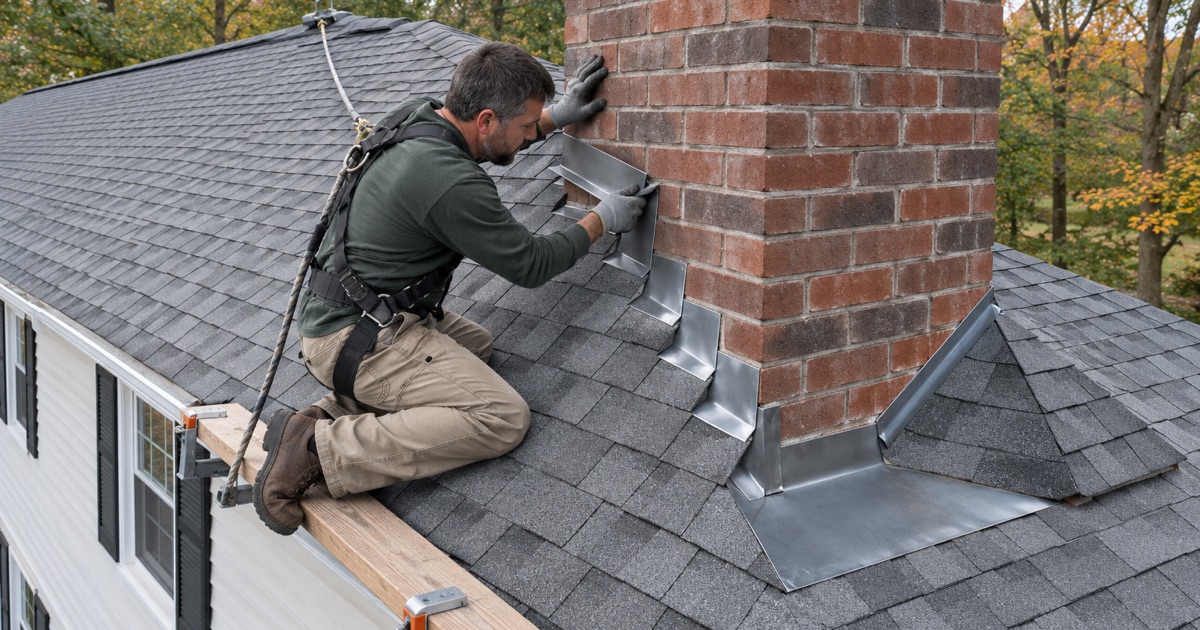
Along the sides of a chimney, step flashing is woven into each course of shingles and turned up against the brick. Counter flashing then covers the top of the step flashing, cut into a mortar joint or a reglet so water running down the brick cannot get behind it. When either layer is missing, rusted or simply sealed with caulk, water runs straight into the roof deck and down the chimney chase into the house.
Apron Flashing on the Low Side
The front of the chimney, facing down the roof, is sealed with a single apron flashing that laps over the shingles below. It is usually the easiest part of the flashing to get right, but it is often bent, lifted or nailed through, letting water into the joint. We replace aprons with new metal and tie them into the counter flashing above, so the low side sheds water cleanly onto the roof.
Why We Replace Flashing, Not Seal It
Roof cement and caulk are a common shortcut on chimneys, and they hold for a season or two before cracking in the sun and cold. Real flashing is metal lapped so water runs over it in the right direction, with no reliance on sealant. That is why we replace step, counter and chimney flashing whenever we replace a roof, and why our chimney repairs use new metal rather than another layer of tar.
Crickets and Water Behind the Chimney
What a Cricket Does
On the uphill side of a chimney, water from the roof above runs straight into the brick and has nowhere to go. A cricket, also called a saddle, is a small peaked roof built behind the chimney that splits the water and sends it around both sides. Without one, water and debris pool against the chimney, and that back corner becomes the most common source of chimney leaks.
When a Cricket Is Required
The residential code, IRC R1003.20, requires a cricket behind chimneys wider than 30 inches that are not on the ridge. Many older chimneys around Jackson were built without one, or with a cricket too small to do its job. We frame and sheath a properly sized cricket, cover it with ice and water barrier and flashing, and tie it into the surrounding roof.
Crickets Under Pine Needles
On lots with tall pines, needles collect in the pocket behind a chimney and hold water against the brick and flashing. A cricket keeps that pocket from forming, but even a well-built one benefits from being cleared during gutter cleaning. We point out chimneys that sit in heavy needle fall so you know where to look.
Crowns, Caps and Masonry Above the Roof
Chimney Crowns
The crown is the concrete or mortar slab that seals the top of a masonry chimney around the flue. When it cracks, water soaks into the brick below and freezes in winter, breaking the masonry apart from the inside. We repair hairline cracks with an appropriate sealant and rebuild crowns that are broken or were built without enough overhang to shed water away from the brick.
Chimney Caps
An uncapped flue lets rain fall straight down into the chimney, along with leaves, needles and animals. A metal cap with a mesh screen keeps out rain and pests while letting smoke and exhaust escape. We fit caps sized to the flue or flues, and replace rusted caps that have started dripping onto the crown.
Repointing Mortar Joints
Mortar between the bricks wears away faster than the bricks themselves, especially on the weather-facing side of the chimney. Open joints let water into the masonry and the chimney chase. We grind out deteriorated mortar and repoint it with compatible mortar, and we tell you if bricks are spalling badly enough that the chimney above the roofline should be rebuilt.
Other Chimney Situations
Framed Chimney Chases
Many newer homes have framed chimney chases covered in siding, with a metal chase cover on top instead of a masonry crown. These covers rust, dish in the middle and hold water, which then leaks around the flue pipe. We replace them with properly sloped covers and check the siding and flashing where the chase meets the roof.
Removing an Unused Chimney
If a chimney no longer serves a fireplace, furnace or water heater, taking it down below the roofline removes a recurring leak point. The opening is framed, decked and roofed over to match. We check first that nothing still vents through it, because removing an active flue would create a safety problem.
Chimneys and Roof Replacement
The best time to fix chimney flashing and add a cricket is during a roof replacement, when the surrounding shingles are already coming off. Our roof scopes list chimney flashing as its own line, so you can see what it costs. If the masonry needs repointing or a new crown, we schedule that work before the new roof goes on, so the finished roof is not disturbed by masonry work afterward.
- 20+ Years in Business
- Free Written Estimates
- Attic Checked on Every Leak Call