Jackson Elite Roofing brings more than 20 years in the trade to roofing in Holmdel, and this page is about the roofs that behave least like a house. A low-slope roof over an office, a medical suite or a mixed-use building does more than shed rain. It holds mechanical units, skylights and sometimes people, so every decision about it has to account for what sits on top and who works below.
That changes how the work is priced and scheduled. Before anyone talks about tearing a commercial roof off, we tell the owner or property manager plainly whether the existing one can be repaired, and we trace any leak from the inside as well as from above. If replacement turns out to be the answer, the schedule is built around the people working underneath.
The sections below cover what makes Holmdel’s office roofs their own category, how leaks over occupied space get handled, and how a replacement can be split into phases so tenants keep working. If you manage or own a building in Holmdel with a roof that holds more than weather, that is the work this page is written for.
Bell Works and the Roof That Became a Workplace
A 1960s Research Campus on Crawfords Corner Road
Holmdel’s largest roof sits over the former Bell Laboratories building on Crawfords Corner Road. The National Park Service records it as constructed between 1959 and 1966 to the design of Eero Saarinen and Associates, and it was listed in the National Register on June 26, 2017. By 2006 the building stood empty and was slated for demolition.
The original design wrapped a sequence of central atriums with windowless research labs, a plan built for engineers rather than for tenants. Turning that into leasable space meant rethinking the whole envelope, and the roof was where the most visible change happened. We had no part in that project, but it shows what a commercial roof in this township can be asked to carry.
Seven Years of Rehabilitation
The conversion into Bell Works took about seven years and was completed using historic tax credit equity, with the finishing touches put on in early 2021, according to Heritage Consulting. The work covered the entire building, not one wing at a time, which is the scale at which roofing stops being a trade visit and becomes part of a construction program.
Most office roofs in Holmdel will never see a project like that. Still, the same logic applies at a smaller size: a roof over a working building is scheduled against leases, deliveries and business hours, and the roofer is one contractor among several who need the same access. Owners of those buildings feel every day a roof crew stays longer than planned.
Why the Building’s Story Matters to a Roofer
A National Register listing belongs to that one building, and it says nothing about how any other office in town is reviewed. What Bell Works does show is that a large low-slope roof here can be expected to hold far more than a membrane. Owners planning their own work should list everything that lives on the roof before anyone prices it.
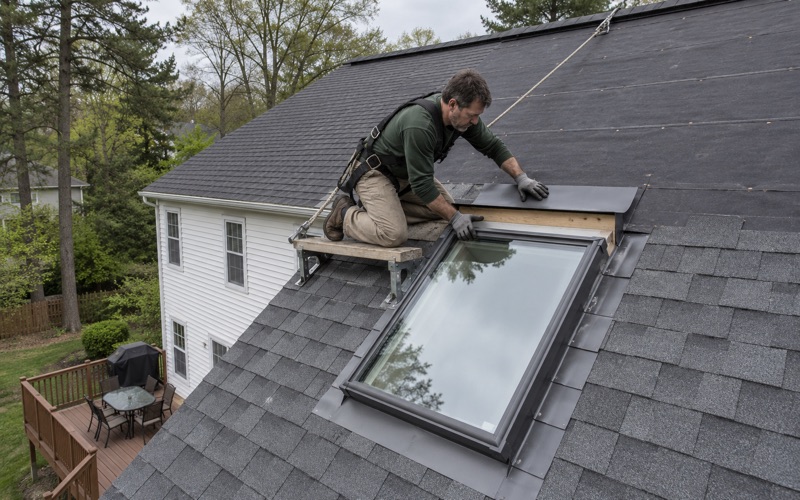
For a smaller office or a converted building, that inventory might be a handful of rooftop units, a few skylights and a satellite dish. Each item changes how a crew stages work and what has to be disconnected, protected or lifted, and leaving one off the list is how a replacement schedule slips by a week.
Looking for roofing closer to Southampton? See Roofing Services in Southampton.
Glass, Equipment and a Hotel on the Roof
Photovoltaic Glass as Part of the Roof
During the rehabilitation, Alexander Gorlin Architects reconstructed the Bell Works roof with clear photovoltaic glass, described in the AZ Awards 2021 as the world’s largest such installation. It generates about 15 percent of the building’s electricity. Here the glazing is not something bolted on afterward; it is part of the roof itself, and it keeps the weather out while it works.
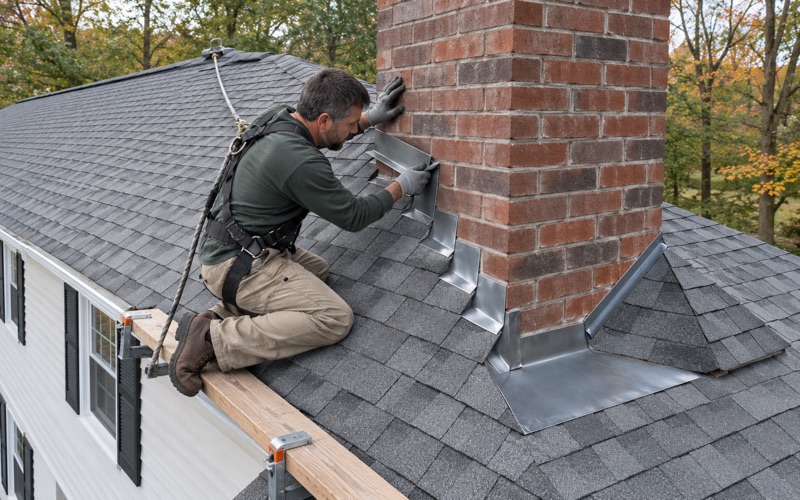
That matters for anyone who maintains the surrounding surfaces. Where a glazed section meets a conventional roof, the joint between them is flashing work, and it is where water looks for a way in. Glazing systems are a specialty outside our work, but we pay close attention to every edge where a membrane has to meet something that is not a membrane.
A Hotel Approved Along the Rooftop
In February 2018, Jersey Digs reported that Holmdel officials had approved a 200-room hotel at Bell Works, with rooms to be constructed along the perimeter of the rooftop. The plan kept the 60,000-square-foot photovoltaic skylight that runs the length of the building. Whether that hotel was ever built is not something we have confirmed, so we treat it as an approval on paper.
Even as a proposal, it says something useful. Local officials were willing to consider occupied rooms on top of an office building, which means a roof in Holmdel can be planned as floor space. Once people sleep or work on a roof, its drainage, walkways and edge protection become questions about occupants, not only about rain.
Rooftop Equipment Shares the Surface
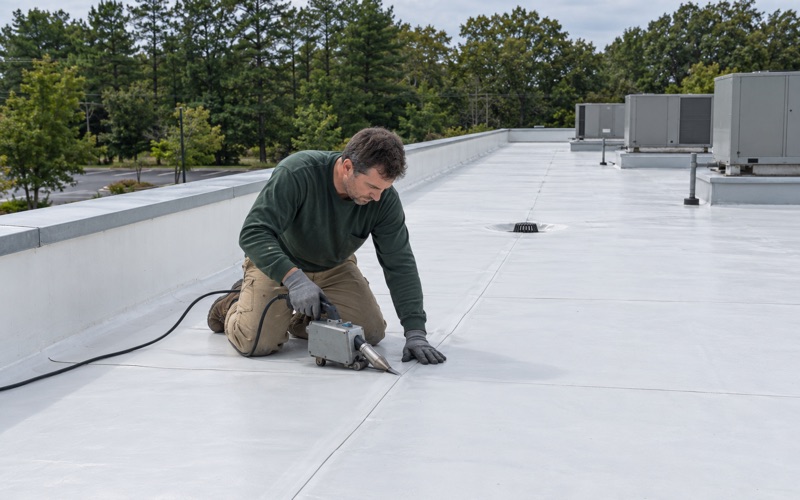
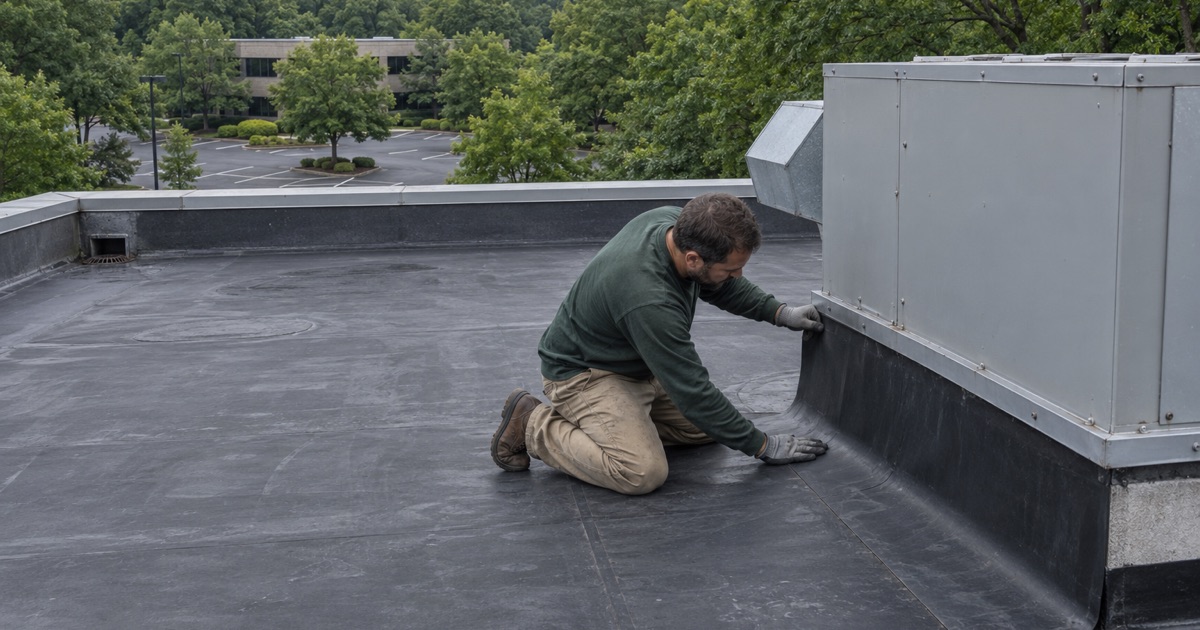
Office roofs carry air handlers, condensers, exhaust fans and the curbs and conduit that serve them. Each penetration is a seam that has to stay watertight while technicians walk to and from the units in every season. On a busy roof, foot traffic wears a path into the membrane long before the open field shows any age.
When we look at a low-slope roof, we walk those service routes first and check the curb flashing at every unit. Walkway pads, raised curbs and clearly marked paths cost far less than patching the same worn strip every spring, and they belong in the written scope as their own line. Equipment that has to be lifted for a replacement is coordinated with the mechanical contractor well ahead of tear-off.
Low-Slope Roofs and Leaks Over Occupied Offices
What Covers a Holmdel Office Roof
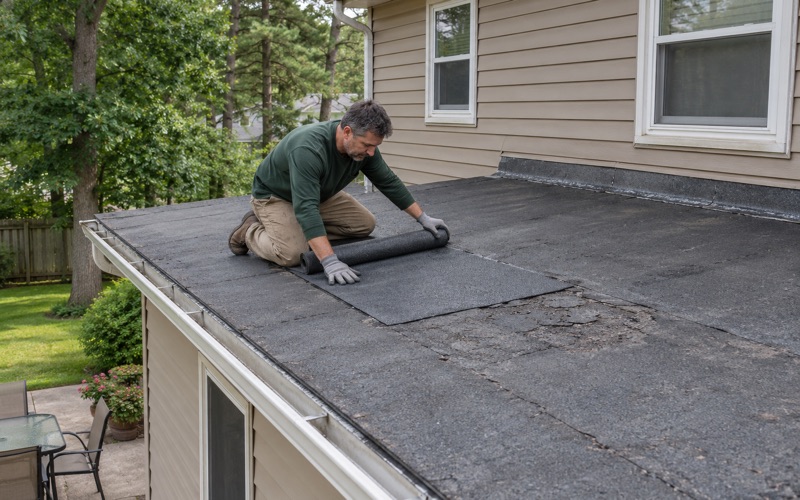
Low-slope commercial roofs in New Jersey are usually covered with a single-ply membrane such as TPO, PVC or EPDM rubber, or with modified bitumen applied in torch-down or cold-applied layers. Every building is different, so we never assume which system a particular Holmdel office has; the first visit identifies it, along with how many layers sit beneath it.
Each system ages in its own way. Single-ply seams can open, bitumen can blister and crack, and any of them can hold water in low spots where the deck has sagged. Knowing the system tells us which repairs are realistic and which would only buy a season. When a system is replaced, we replace its wall and curb flashing too, because old metal under a new membrane is where the next leak starts.
Tracing Water That Travels Under the Membrane
A leak over a suite of offices is rarely directly above the wet ceiling. Water gets in at a seam, a curb or a drain, runs along the deck or through the insulation, and drops wherever it finds a fastener or a gap. That is why we check from inside the building as well as from the roof surface.
Wet insulation is the hidden cost of a slow leak on a low-slope roof. It stops insulating, adds weight and can stay saturated long after the surface is patched. When we find it, we mark the wet area, show the owner what we found and price its replacement as a separate line rather than burying it.
Drains, Scuppers and Standing Water
Flat roofs are never perfectly flat; they rely on interior drains, scuppers and gutters to move water off. A clogged strainer or a drain set slightly high leaves ponding that works on the membrane for days after every storm. Holmdel sits in the National Weather Service’s Western Monmouth forecast zone, served from the Mount Holly office, and its storm warnings are a good prompt to clear drains.
We check drain bodies, clamping rings and the slope toward each outlet whenever we are on a commercial roof. Where ponding keeps returning, tapered insulation or an added drain usually solves more than another coat of patching compound ever will. Gutters and leaders on the building’s lower roofs get the same check, since an overflowing leader can stain a facade in a single storm.
Replacing a Commercial Roof Around Tenants
Repair First, If Repair Is Honest
Many commercial roofs that look tired have years left once the seams, flashings and drains are dealt with. We tell owners directly when a repair or a restoration makes sense, and when it does not, we explain why with photos. Replacing a whole low-slope roof is disruptive enough that it should only happen when the existing one has truly run out.
A core cut tells us how many layers are already there and whether the insulation is dry. If the deck below is sound and most of the insulation is dry, a targeted repair often outperforms a hurried replacement. If wet areas cover too much of the roof, that is when replacement enters the conversation.
Working in Phases Over Occupied Space
A replacement over a working building is usually split into sections, each torn off and made watertight the same day. Phasing lets tenants keep using their suites, keeps the interior protected if weather turns, and gives the property manager a clear map of which area is affected on which date. Sections are sized so a crew can always close what it opened before dark.
Noise and odor are the complaints tenants actually raise. Tear-off is loud, and some adhesives and hot-applied systems carry a smell into air intakes, so we coordinate with building management on which units to shut down and which hours to avoid. Loud work near a medical or conference suite can often move to early mornings.
Access, Safety and the Written Scope
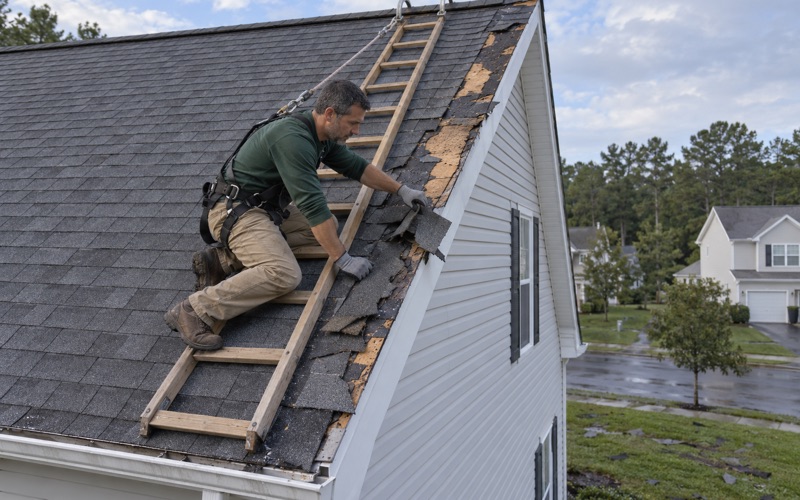
Material has to reach the roof without blocking a parking lot full of tenant cars, so crane or hoist placement, staging areas and debris chutes are agreed before work starts. Edge protection and fall protection go up first, and the work area is cleaned at the end of every day, including a magnet sweep for fasteners around entries and parking.
Our written scope separates tear-off, deck replacement, insulation, membrane, flashing at walls and curbs, and drainage work into individual lines. Damaged decking found after tear-off is photographed and shown to the owner before it is replaced, at a unit price set in the contract, so nothing is added quietly mid-job.
- 20+ Years in Business
- Free Written Estimates
- Attic Checked on Every Leak Call