Jackson Elite Roofing brings more than 20 years in the trade to roofing in Lumberton, and on attached homes the first thing we settle is not shingle color or brand. It is who actually holds the roof. One continuous roof can run over four or six separate owners on a townhouse row, and the documents behind it decide who pays, who schedules the work and who signs.
So before any estimate is written, we read the association’s governing documents against the roof in question. If the homeowners association holds the roof, our conversation is with the board or its manager, and the owner hears what is planned. If the owner holds it, we price that one section and plan how it meets the neighbors’ shingles on both sides.
Either way the scope we hand over is itemized, with tear-off, decking, underlayment, flashing, ventilation and gutters each on a separate line. That matters more on attached homes than anywhere else, because a board comparing bids for a whole row, or an owner comparing two quotes for one unit, needs to see exactly where the numbers differ.
Lumberton’s Townhouse Communities and How They Differ
1,130 Attached Homes, Many Roofing Arrangements
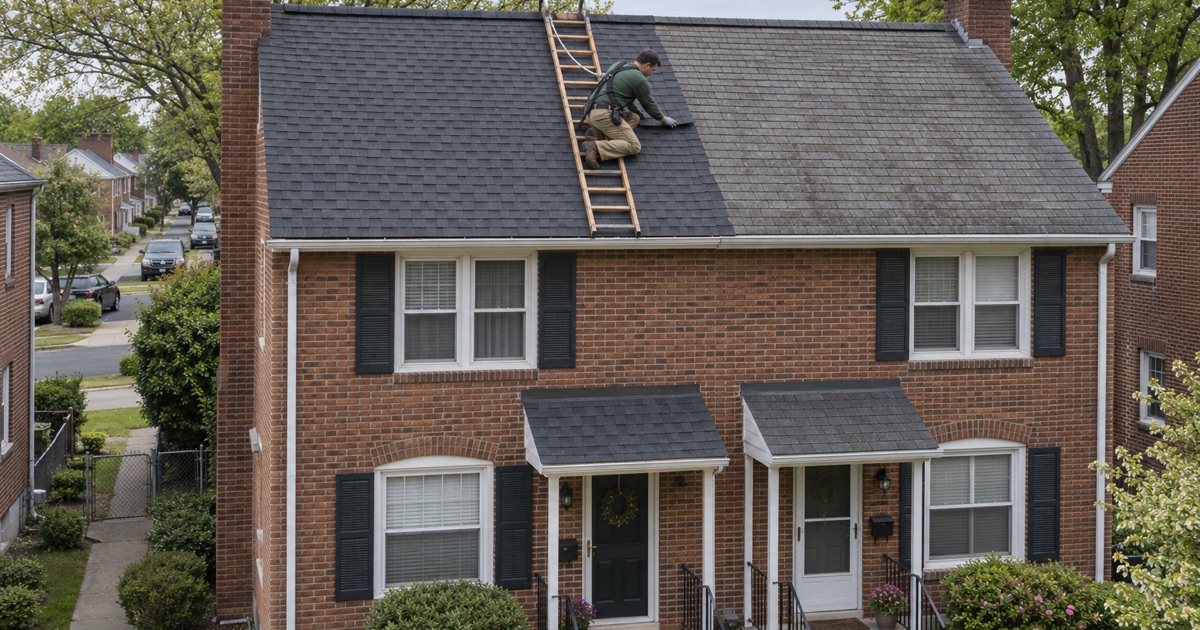
Lumberton counts 1,130 one-unit attached homes in the most recent five-year Census estimates, and 740 of them are owner-occupied. That is more than a fifth of the township’s housing, spread across communities built in different decades. Each community runs under its own governing documents, and nothing requires the roof provisions in one to match those in another.
Two listings show how far apart those arrangements can sit. They are not proof of any community’s rules, only what sellers described, but they are a useful reminder that a friend’s experience across town tells you little about your own roof. The only reliable answer is in your community’s paperwork.
Sunnybrook, Off Eayrestown Road
Sunnybrook is a 240-home association reached from Eayrestown Road. A township resolution in 2015 authorized reimbursing the Sunnybrook Homeowners Association for municipal services in 2013, including leaf collection for those 240 homes and snow removal on 1.5 miles of road, which gives a sense of how much the association runs on its own.
A 1977 interior row townhouse there was listed with a $305 monthly fee, and its listing named a new roof among the amenities the association provides on a timely schedule, beside exterior and fence painting. That line describes one listing. It does not tell an owner when the next roof is due, how it is funded or whether every building is treated alike.
Country Estates and the Owner-Paid Roof
Country Estates reads differently. A 1987 end-of-row townhouse there was listed with a $75 monthly association fee covering common area maintenance, lawn care and snow removal, and the roof did not appear on that list. Instead, the seller named a new roof from 2025 among the updates made to the home.
Other Country Estates listings show different fees and billing periods, which is another reason not to treat any single figure as the rule. One owner paying for a roof also does not prove the association never takes one on. What it shows is that an owner in this community may well be the person hiring the roofer.
Looking for roofing closer to Burlington? See Burlington Roofing.
When the Association Schedules the Roof
Working With the Board and Its Manager
Where the homeowners association holds the roof, the board decides timing and scope, often through a manager, and pays from the association’s own funds. Our job then is to give the board something it can actually compare: a written scope per building, with each component priced on its own line rather than buried in one lump figure.
We also keep the owners living underneath informed when the board allows it. An owner whose ceiling stains before the scheduled replacement still deserves a straight answer on whether a repair will hold, and every leak call includes a look in the attic as well as on the roof, so the board hears where the water actually enters.
Solar panels complicate a shared schedule. Where an owner has panels on a section the association plans to replace, the removal and reinstall need to be in the schedule from the start, coordinated between the board, the owner and the solar company, not discovered on the day the crew arrives.
Reserves and Planning a Replacement Cycle
New Jersey’s planned real estate development statute addresses association capital reserve studies under N.J.S.A. 45:22A-44.2. On a townhouse community, roofs are usually among the largest items such a study covers. When a board asks, we document the age and condition of each roof section so its reserve planning rests on what is actually on the buildings.
None of that tells an individual owner in Lumberton what their own association has set aside, and we never assume it. If a reserve schedule shows your building next in line, that is worth knowing before you spend your own money patching a roof the association may be about to replace.
Permit Work on Attached Homes
Replacing the roof covering on a detached one- or two-family house is ordinary maintenance in New Jersey under N.J.A.C. 5:23-2.7, with no permit needed. That item does not reach attached townhouses, so a townhouse re-roof in Lumberton is permit work. We build that step into the schedule rather than treating it as an afterthought.
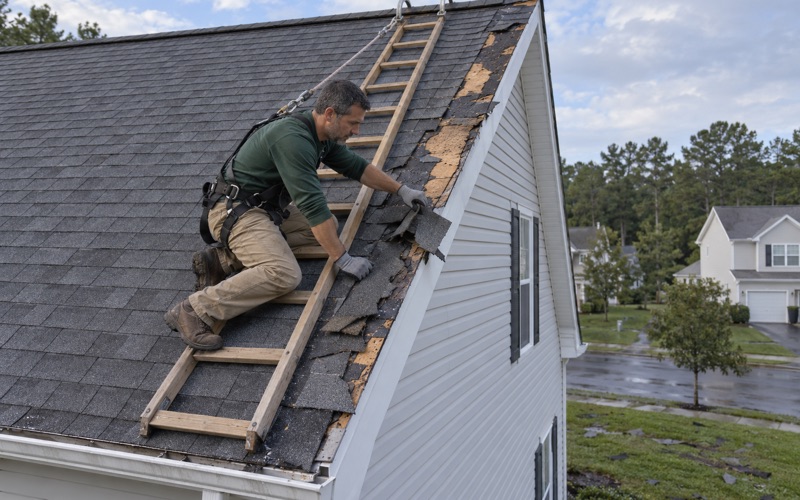
The rehabilitation subcode adds its own condition: where two or more layers of roofing already exist, or the existing covering is slate, wood shake or tile, the old material comes off before new goes on. On a 1977 or 1987 townhouse that has been overlaid once, that decides whether the price includes a full tear-off.
When the Roof Is the Owner’s Job
Pricing One Section of a Shared Roof
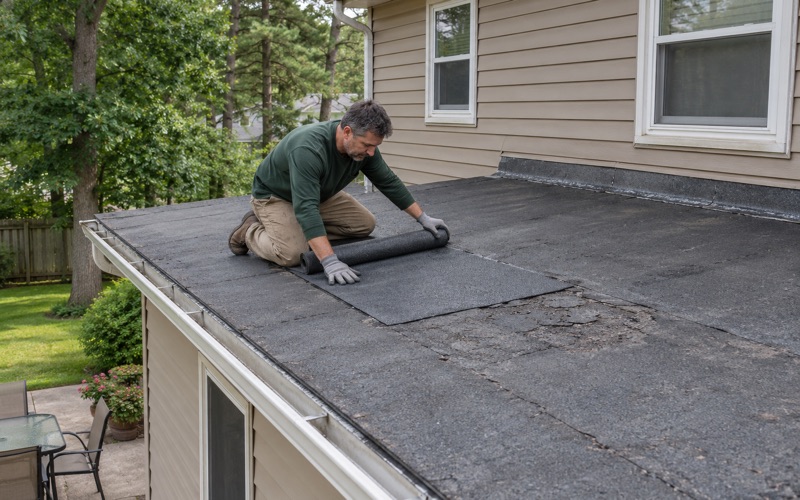
When the owner holds the roof, we price only the section above that unit, measured from party wall to party wall. Tear-off, decking, underlayment and flashing are all listed separately, and any rotted sheathing found once the old roof is off is photographed and shown to the owner before it is replaced, at a per-sheet price already set in the contract.
Contracts follow New Jersey’s home improvement rules, including the three-business-day cancellation right. An owner replacing a roof as a capital improvement may also run into Form ST-8, the Certificate of Exempt Capital Improvement, which is worth asking about before the invoice is drawn up rather than after. We explain both in writing at signing.
End-of-Row Units Carry More Roof Edge
An end-of-row townhouse usually has an exposed gable that interior units do not. That means a rake edge with its own drip edge and often a longer run of fascia and rake trim. Those lines belong on the estimate, because they are where an end unit’s price legitimately differs from its neighbor’s.
On a unit built before 1978, painted trim and fascia also bring the EPA lead-safe rule into play when that wood is disturbed. The Sunnybrook townhouse listed as built in 1977 falls inside that cutoff, so if trim along a roof edge needs replacing, we plan the work under lead-safe practices from the start.
Matching Shingles and Planning a Sale
An owner-paid roof on a row sits beside roofs of different ages, so the shingle choice matters. We look at what the neighbors have, whether the association’s rules set a color or profile, and which architectural shingles, such as GAF Timberline HDZ, Owens Corning Duration or CertainTeed Landmark, come closest to a visual match.
The Country Estates seller listed the 2025 roof among its recent updates, and buyers do notice that. When a townhouse is going on the market, we write a roof condition report the seller can hand to the buyer’s inspector, noting the section’s age, its flashing and how it joins the units on either side.
One Roofline Over Several Owners
Tying a New Section Into the Neighbors’ Roofs
Where one owner re-roofs and the units on either side do not, the new section has to meet old shingles at the party wall line. We cut back cleanly, weave or lap the new courses into the existing ones where the material allows, and make sure underlayment runs past the joint so water cannot follow the seam.
That joint is also where disputes start. Before we touch it, we tell the neighbors what will happen at the line, photograph their side as it stands, and agree on access, so nobody later wonders whether a crack in their shingles came from our crew or from the age of their own roof.
When an entire row is replaced at once, the joints disappear and the ridge and flashing run continuously. That is one reason an owner holding a roof that is close to the end of its life may want to talk with the neighbors first. Coordinating three or four owner-paid sections into one project usually produces a cleaner roofline than three separate jobs years apart.
Flashing at Walls, Chimneys and Pipes
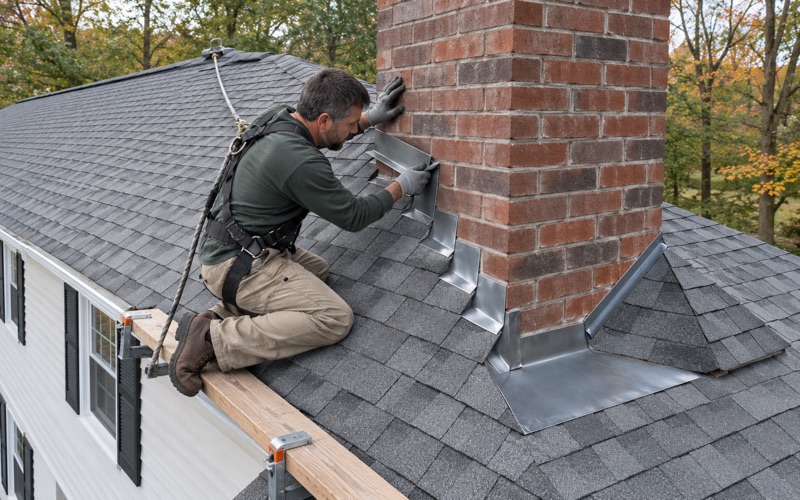
Townhouse rows often step up or down between units, leaving sidewalls where one roof meets the next unit’s siding. Step and counter flashing at those walls is replaced with the roof, never reused under new shingles, because old flashing left at a sidewall is a frequent leak point.
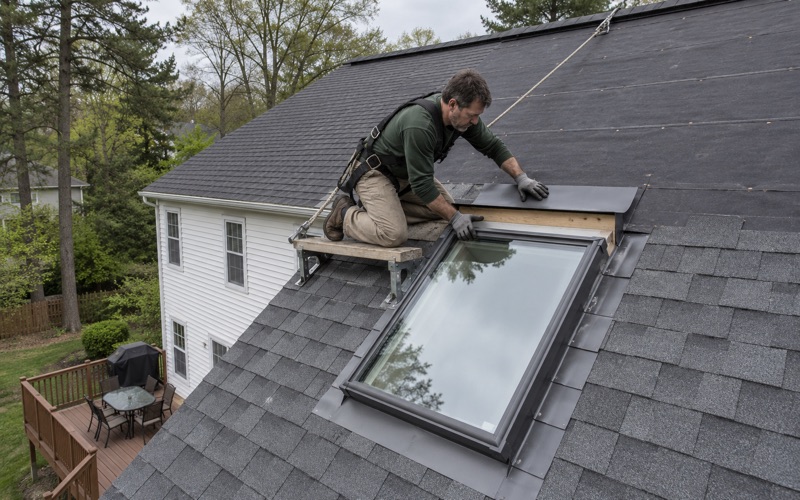
Each unit also brings its own penetrations: plumbing vents, exhaust fans and sometimes a chimney. Pipe boots are replaced with the roof, and a chimney wider than 30 inches gets a cricket behind it under IRC R1003.20, so water is turned aside before it pools against the masonry above the living space.
Questions to Settle Before Work Starts
Before anyone signs, we work through a short list with the owner and, where needed, the association: who holds the roof under the declaration, whether the board must approve the shingle or the contractor, and whether the building already sits on a reserve schedule. We also settle who pays for the joint where a new section meets an older neighbor’s roof.
If storm damage is involved, the answer to whose roof it is usually also decides whose insurance claim it is. We photograph and write up the damage for whoever holds the roof, meet the adjuster on site when asked, and keep the driveway, yard and gutters clean at the end of every day, with a magnet sweep for nails along shared walks.
Trees matter on a row too. Overhanging pines and oaks are looked at with the roof, because a limb that scrapes one unit’s shingles in every wind is part of that roof’s condition, and trimming it may need the association’s sign-off if the tree stands on common ground.
- 20+ Years in Business
- Free Written Estimates
- Attic Checked on Every Leak Call