Jackson Elite Roofing has spent more than 20 years on roofing in Red Bank and across Monmouth County, and the borough asks something of a roofer that a street of split-levels does not. A large share of its homes sit under flat, low-slope roofs on apartment buildings, where the failure that matters most starts at the roof edge rather than in the middle of the field.
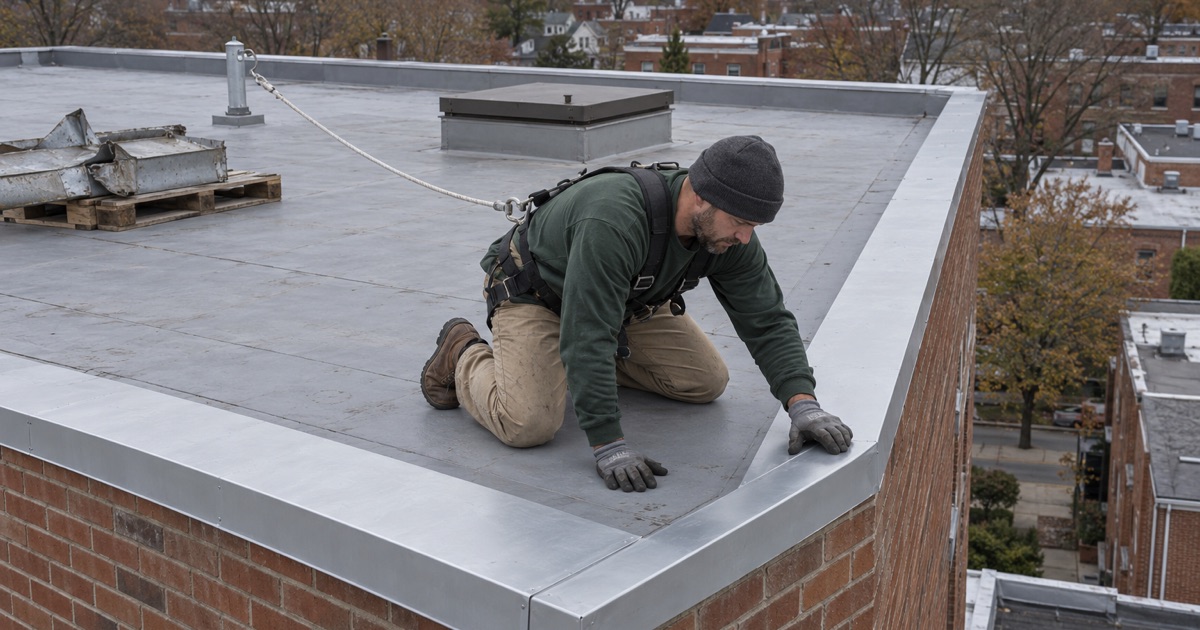
We work on pitched roofs too, from detached houses to two-family homes, but this page is about the buildings where a single gust can lift a membrane at the perimeter and peel it back toward the center. Owners, boards and property managers call us to find out what is holding that edge down, whether it can be repaired, and what a fair scope looks like before anyone talks about a new roof.
Every visit starts with two looks: one from the roof surface and one from below, in the attic or the space above the top-floor ceilings, so we trace water to where it actually enters. You get a straight answer on repair first. Replacement only comes up when a repair would not hold, and the written scope then puts each item on its own line.
Sandy, Grandville Towers and Red Bank’s Tall Flat Roofs
What happened on Morford Place in 2012
On October 29, 2012, as Hurricane Sandy came ashore, Red Bank Green reported that strong winds peeled back the roofing atop the Grandville Tower high rise on Morford Place. The material was left hanging over the edge of the building, and a later photo caption in the same outlet said the winds tore off the roof liner at Grandville Towers.
We had no part in that building’s repair and know nothing about its roof today. We point to it because it is the one recorded wind failure on a tall flat roof in the borough, and it shows exactly where these roofs give way. The covering did not puncture in the middle of the deck; it lifted at the perimeter and went over the side.
A 10-story building from 1973
Grandville Towers stands at 19 Morford Place, a 10-story apartment building completed in 1973. A roof at that height has no trees or neighboring rooftops to break the wind, and the edge detail is the only thing standing between the membrane and open air. Wind that climbs a tall wall does not stop at the top; it rolls over the edge and across the roof.
That description is general roofing knowledge, not a measurement taken during the storm. We found no measured Sandy wind speed for the borough itself, so we quote none. What the record does show is the result: the liner came loose and ended up over the building’s edge, which is exactly where an inspection on a similar roof should begin.
How many Red Bank homes sit under these roofs
The Census Bureau’s 2024 American Community Survey five-year estimates count 6,216 housing units in Red Bank. Of those, 1,064, about 17 percent, are in buildings of 50 or more units, and another 309 are in buildings of 20 to 49 units. Buildings of that size typically carry low-slope membrane roofs rather than shingles.
For the residents of those apartments, the roof is a shared system they never see. A loose edge on the top of a tall building shows up as a stain on a top-floor ceiling, or as water in a stairwell weeks later. That gap between cause and symptom is why we check the roof and the interior below it on the same visit.
Looking for roofing closer to South River? See South River Roofing.
Why Wind Lifts a Flat Roof at the Edges and Corners
Pressure at the perimeter
When wind strikes a building and flows over the roof, it creates suction above the surface. That uplift is strongest along the perimeter, where the airflow separates from the edge, and stronger still at the corners, where wind from two directions meets. The middle of a large flat roof usually sees the least of it.
This is why a membrane that looks sound across the field can still fail. If the perimeter attachment loosens, the wind gets a lip to grab, and a small lifted edge can turn into a peeled sheet within one storm. The Grandville Towers liner hanging over the side is what that sequence looks like when it runs to the end.
Corners take the hardest pull
Corners deserve their own inspection. On a well-designed roof, fasteners, adhesive and edge metal are often more concentrated there, because designers expect the highest uplift in those zones. On an older roof, or one patched many times over the years, the corners may have no more attachment than the field, and that is where we look first.
We also check where rooftop equipment, hatches and drains sit near the perimeter. Anything that breaks the edge line, from a vent stack to a gap at a parapet return, gives the wind another place to start. A loose seam close to a corner is a repair we would much rather make in calm weather than after the next storm.
Membranes common on low-slope roofs
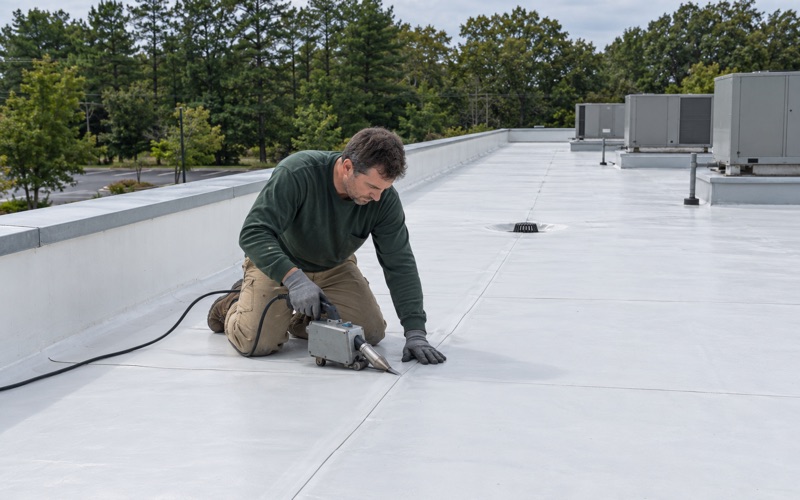
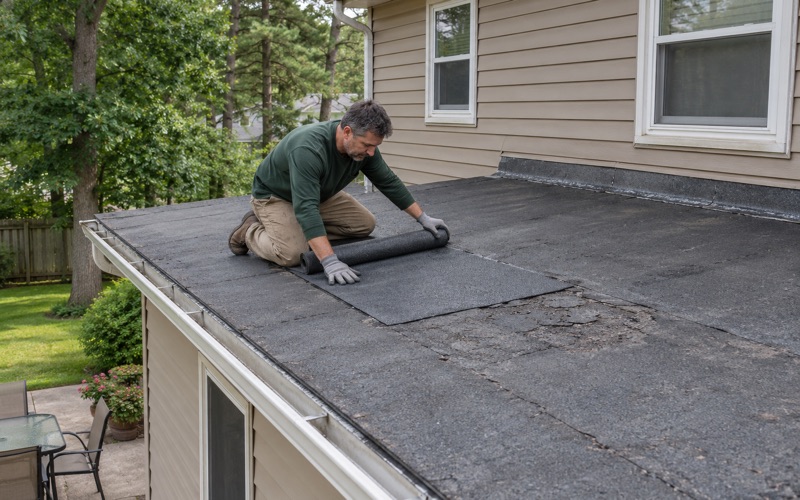
Low-slope roofs on apartment buildings are covered with a membrane rather than shingles. The common systems are EPDM rubber, TPO and PVC single-ply sheets, and SBS or APP modified bitumen, some of it torch-applied. Each is held at its edge differently, by termination bars, metal flashing, adhesive or a combination of them.
We identify which system is on a roof before quoting any work on it, because the right edge repair depends on the membrane. A torch-down modified bitumen edge and a mechanically fastened TPO edge are not fixed the same way, and a patch made with the wrong material can fail sooner than the original sheet around it.
Edge Metal, Copings and the ES-1 Test Standard
What edge metal and copings do
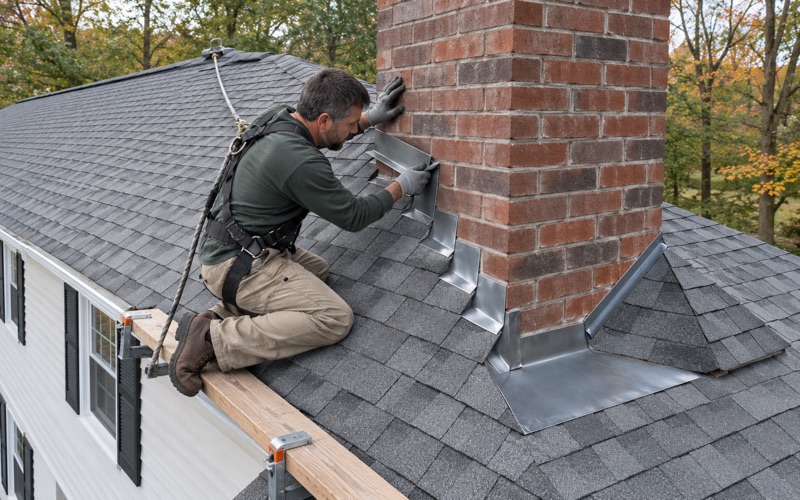
On a low-slope roof, the edge metal is more than trim. A gravel stop or drip edge clamps the membrane at the roof edge, and a coping caps the top of a parapet wall, wrapping over both faces so water and wind cannot get underneath. When either one loosens, the membrane edge it was holding is suddenly exposed.
We look for lifted cleats, loose or missing fasteners, open joints between coping sections, and sealant that has pulled away. Rust streaks and bent sections are clues that the metal has been moving in the wind. Every one of those findings goes into a written note with photos, so the owner or board sees what we saw.
The ANSI/SPRI ES-1 standard
The current International Building Code, as summarized by the National Roofing Contractors Association, calls for metal edge systems on built-up, modified bitumen and single-ply low-slope roofs to be designed for wind loads and tested for resistance under ANSI/SPRI ES-1. That standard’s RE-1, RE-2 and RE-3 test methods measure how well an edge holds when pulled.
ES-1 describes how edge products are tested; it is not a label we apply on a roof, and we do no wind-load calculations or edge testing ourselves. What it gives an owner is a question to ask when edge metal is replaced: does the product carry ES-1 test results, and was it installed the way it was tested? We price edge work with that answer in hand.
Gutters that hold the membrane edge
Some low-slope roofs drain to gutters that also secure the membrane edge. The same NRCA summary notes those gutters fall under a separate standard, SPRI GT-1. On those roofs, a sagging or loose gutter is not only a drainage problem; it can be the first part of the edge to let go in a storm.
We size and pitch replacement gutters and leaders with the roof rather than as an afterthought, and we confirm the hangers and straps are fastened into solid material. A gutter that pulls away under the weight of water will pull away faster under wind, and it can take the membrane edge along with it.
Checking a Building’s Roof Edge After a Big Wind
What we inspect first
After a strong storm, we start where the Grandville record says to start: at the roof edge. We walk the perimeter, then each corner, looking for lifted metal, displaced coping, wrinkles or bubbles just inside the edge, and any seam that has opened. Debris pushed into a pile can show which way the wind moved across the roof.
Then we go inside. Top-floor units, stair towers and the space above ceilings often show water before the roof shows a hole, and a leak that appears days after a storm can usually be tied back to one edge or flashing. Red Bank sits in the National Weather Service’s Western Monmouth forecast zone, so a wind advisory from the Mount Holly office is a good cue to book that check.
Repair or replace, stated plainly
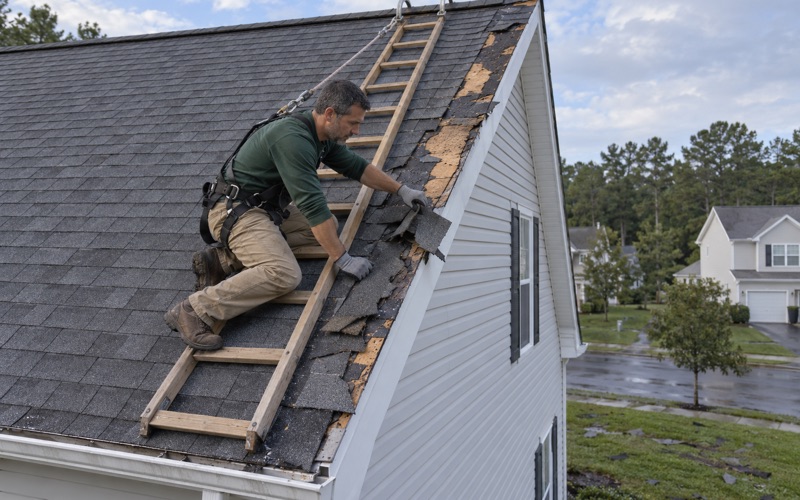
Most wind damage at an edge is repairable if it is caught early. Refastening edge metal, replacing a run of coping or rebuilding a lifted perimeter strip is usually far less work than a new roof, and we say so before replacement ever comes up. When a membrane has aged past saving, we say that just as plainly.
When full replacement is the right call, the written scope lists tear-off, deck repair, insulation, edge metal, flashing and drainage as separate lines, so a board can compare two bids item by item instead of two totals. Damaged decking found after tear-off is photographed and shown to the owner before it is replaced, at a per-sheet price set in the contract.
Documenting storm damage for a claim
If wind has damaged the roof, we photograph the edge, the corners and any interior water, then write up what we found for the owner’s own insurance claim. When the owner asks, our crew meets the adjuster on site and walks the roof with them. The claim stays the owner’s; our part is an accurate record of the roof.
Our home improvement contracts are written to New Jersey’s rules, including the three-business-day cancellation notice. Each workday ends with the ground below the roof cleaned up and a magnet sweep for nails, which matters on a building where residents walk past the work every morning and evening.
- 20+ Years in Business
- Free Written Estimates
- Attic Checked on Every Leak Call