Jackson Elite Roofing handles roof repair in Jackson, NJ, serving surrounding cities including Vista Center, Cedar Glen West, Leisure Knoll, Leisure Village West and Plumsted. In more than 20 years of roofing work we have learned that most leaks start at a small number of places, such as a cracked pipe boot, a flashing joint or a valley, and that fixing the right one is far cheaper than replacing a roof that still has years left.
Our repair visits start in the attic as well as on the roof. Water rarely drips straight down from the hole it came through, so we follow the wet path along the sheathing and rafters until we reach the real entry point, and only then do we price the work.
You also get a straight answer before anyone mentions replacement. If a repair will hold, that is what we quote. If the roof is worn out and a patch would only buy one more season, we explain why and show you what we saw.
The Roof Repairs We Do Most Often
Pipe Boot and Vent Flashing Repair
The rubber collar around a plumbing vent dries out and cracks in the sun long before the shingles around it wear out. A cracked boot lets water run straight down the pipe into the attic, often staining a bathroom or hallway ceiling.
We replace failed collars with new rubber pipe boots or lead flashing boots, slipping them under the upper shingle course so water sheds over them. Roof cement smeared around a cracked boot is not a repair; it holds for a few months and fails again.
Step, Counter and Apron Flashing at Walls and Chimneys
Wherever a roof meets a wall, a dormer or a chimney, flashing does the waterproofing, not the shingles. Step flashing runs under each course along the wall, counter flashing covers it, and apron flashing seals the low side of a chimney or dormer.
We rebuild these joints with new metal rather than reusing old pieces that were bent, rusted or nailed through. Where siding meets a roof edge, we add kick-out flashing so the runoff goes into the gutter instead of behind the siding.
Shingle and Ridge Cap Replacement
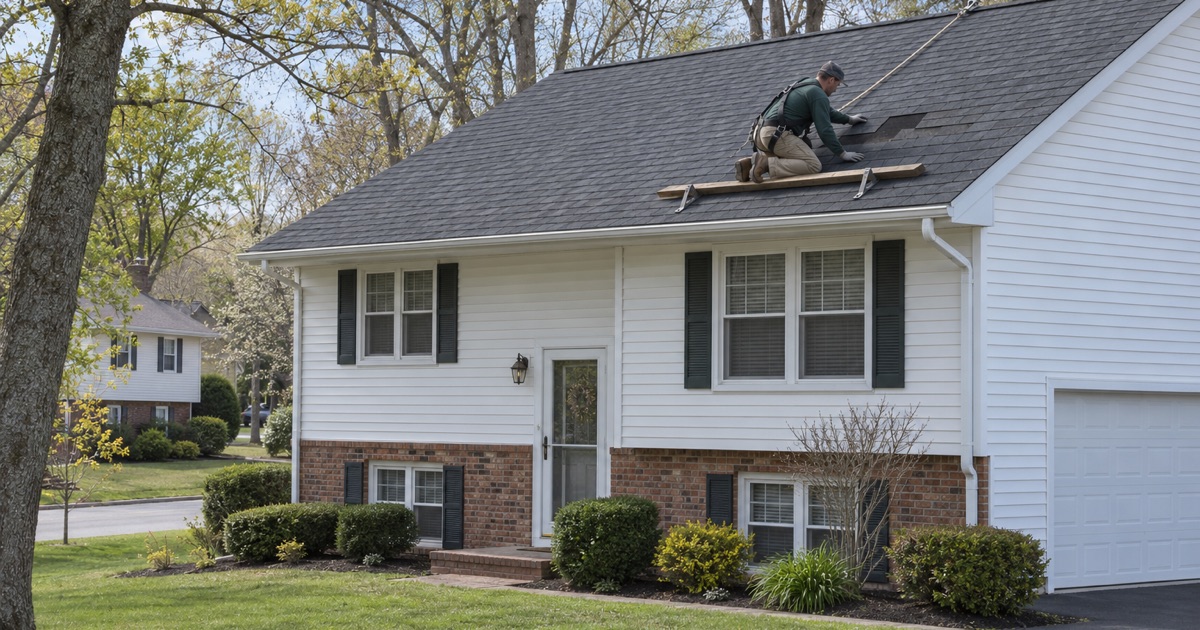
Shingles torn off by wind, cracked by a falling branch or lifted where the sealant never bonded can be replaced individually. We lift the course above, remove the damaged piece and its nails, and set a new shingle with the nailing placed where the manufacturer specifies.
Ridge caps take more wind than any other part of the roof, and a single missing cap opens the ridge vent to driving rain. We replace caps with matching material and check the ridge vent beneath them while the area is open.
Drip Edge and Eave Repairs
The bottom edge of the roof takes every drop that runs off it, and a missing or short drip edge lets water curl back under the shingles and onto the fascia board. The result is soft fascia, peeling paint and a gutter that pulls away from the house.
We replace rotted fascia sections, install drip edge along the eaves and rakes, and reset the gutter so it sits below the metal rather than behind it. When the gutter itself is undersized or packed with needles, we tell you that too, because an overflowing gutter will keep soaking the new wood.
Finding Where the Roof Is Leaking
Following the Water From the Attic
A stain in the middle of a ceiling usually comes from somewhere uphill of it. In the attic we look for darkened sheathing, wet insulation, rusty nail tips and water lines on the rafters, which together point back toward the source on the roof above.
That trace is what makes a repair price honest. Without it, a roofer is guessing, and a guess usually means replacing the shingles directly above the stain while the real gap stays open.
Telling Roof Leaks From Condensation
Not every wet attic is a roof leak. Frost on the underside of the sheathing that melts on a sunny winter day, a bathroom fan that vents into the attic or a sweating duct can all drip onto the ceiling in dry weather.
When the water shows up without rain, we look at ventilation and ducting before the shingles. Fixing a condensation problem with roof work wastes your money, and we would rather tell you it is an attic problem than sell you a repair you do not need.
Valleys, Skylights and Low Spots
Valleys carry the water from two slopes at once, so worn or poorly cut valley shingles leak early, especially under pine needles that hold moisture in the channel. Skylight curbs and deck-mounted skylights leak where the flashing kit meets the shingles.
We clear and reline failing valleys and reflash skylights with the manufacturer’s kit or proper step flashing. If a skylight’s own seal has failed, we tell you whether it can be resealed or should be replaced.
Winter Leaks From Ice Dams
A leak that appears only during a thaw, close to an outside wall, usually comes from an ice dam. Heat from the house melts snow higher up the roof, the water refreezes at the cold overhang, and the pond behind it backs up under the shingles.
A repair at the eave fixes the damaged shingles and decking, and where the roof is opened we add self-adhering ice and water barrier along the edge. We also look at attic insulation and venting, because without addressing the heat loss the dam simply forms again the next winter.
Repairs on Roofs Around Jackson
Older Roofs on Pre-1980 Houses
About a third of Jackson’s homes were built before 1980, and many of those roofs have been re-covered at least once. Repairs on them can turn up an old layer underneath, brittle shingles that crack when lifted or plank decking instead of plywood.
We tell you what we find and what it means for the repair. On houses built before 1978, painted fascia and trim fall under the EPA lead-safe rule, so any disturbed paint is handled to that standard.
Repairs After Wind and Tree Damage
Jackson has large stands of pine and oak, and the township was hit by two EF-2 tornadoes on April 1, 2023, so limb damage is a regular part of our repair work. A branch that punctures the deck needs the sheathing replaced, not just shingled over.
We photograph storm damage and write it up for your own insurance claim. When you ask, we meet your adjuster on site to show what we found, while leaving the negotiation of the claim to you.
Commercial and Low-Slope Roof Repairs
Small commercial buildings, porches and additions often have low-slope roofs with torch-down modified bitumen, EPDM rubber or TPO membranes. These fail at seams, at drains and around rooftop equipment curbs.
We repair each membrane with compatible material and the right seaming method. Commercial roofs are permit work in New Jersey, so we plan that into the schedule rather than treating a store roof like a house.
When a Repair Is Not the Right Answer
Signs the Roof Is Past Repair
Curling or cupped shingles across whole slopes, bald patches where granules have washed off and leaks appearing in several rooms mean the roof itself is wearing out. Repairs on a roof in that state tend to fail next to the patch.
We will show you photographs of what we saw and explain why repair stops making sense. You decide what to do next, with a clear picture rather than pressure.
What Changes When You Move to Replacement
If replacement is the honest answer, the conversation turns to layer count, decking, ventilation and material choice. New Jersey’s rehabilitation subcode requires a tear-off once a roof already has two layers, so a third layer is never an option.
Our replacement scope is itemized line by line, so you can compare it against any other estimate. Nothing about a repair visit commits you to that, and the repair quote stands on its own.
- 20+ Years in Business
- Free Written Estimates
- Attic Checked on Every Leak Call