Jackson Elite Roofing handles skylight installation in Jackson, NJ, serving surrounding cities including Vista Center, Cedar Glen West, Leisure Knoll, Leisure Village West and Plumsted. Because we are roofers first, we treat a skylight as a hole in the roof that has to be framed, flashed and waterproofed properly, not as a window that happens to point at the sky.
In more than 20 years of roofing, the skylight leaks we have traced almost always came from the same few causes: improvised flashing, a poorly sealed curb or a unit that had simply outlived its seals. Our installations are built around avoiding those failures.
We install new skylights, replace old ones and reflash existing units during roof replacements. Every job is quoted on a written scope that lists the unit, framing, flashing and interior finish work separately.
Choosing a Skylight
Fixed and Venting Skylights
Fixed skylights do not open and simply bring in daylight, which makes them the least expensive and most weather-tight option. Venting skylights open manually or with a motor, letting hot air and moisture escape, which is especially useful in kitchens, bathrooms and upstairs rooms that run warm in summer. Many venting models include rain sensors that close them automatically when the weather turns.
Deck-Mounted and Curb-Mounted Skylights
Deck-mounted skylights sit directly on the roof deck with a low profile and are designed to work with the manufacturer’s step flashing kit. Curb-mounted skylights sit on a raised wooden curb built on the roof, which is often the better choice on low-slope roofs and when replacing an old curb-mounted unit. We recommend the type that suits your roof’s pitch and the existing opening.
Tubular Skylights
Tubular skylights use a small dome on the roof and a reflective tube to carry daylight into hallways, closets and bathrooms where a full skylight would not fit. The roof opening is small and the installation is simpler, but the flashing still has to be done properly. They are a good way to bring light into interior rooms without a light shaft.
Placement, Framing and Light Shafts
Where a Skylight Should Go
Placement affects both the light you get and how much heat the skylight brings in. South- and west-facing slopes bring in the most sun and the most heat, while north-facing slopes give steadier, cooler light. On Jackson lots shaded by tall pines, we look at where the trees fall across the roof, so a new skylight is not hidden under shade or buried in needles.
Framing the Roof Opening
Most skylights are sized to fit between standard rafter spacing, which avoids cutting structural members. Larger units may require cutting a rafter and adding headers to carry the load around the opening. Because a new opening changes the roof framing, we confirm with the local construction office whether a permit is required before cutting into the roof.
Light Shafts Through the Attic
In rooms with a flat ceiling and an attic above, a light shaft carries daylight from the skylight down to the ceiling. The shaft is framed, insulated and finished with drywall, and it can be straight or flared to spread the light wider. Insulating the shaft properly prevents condensation and heat loss through its walls.
Flashing and Keeping Skylights Dry
Manufacturer Flashing Kits
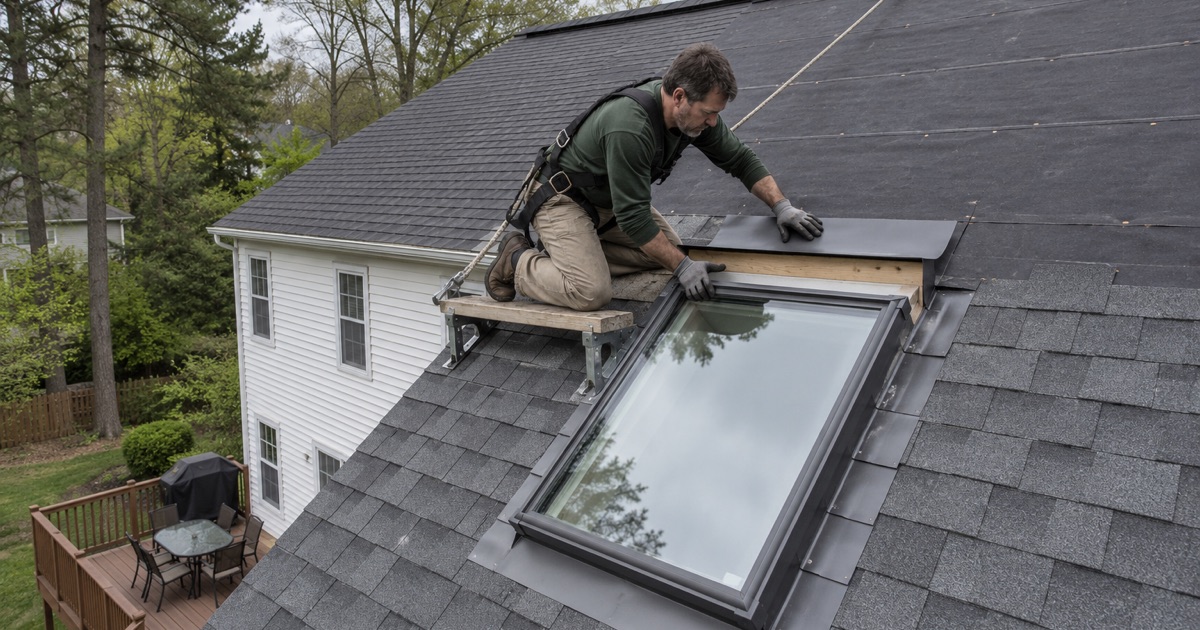
Skylight manufacturers design flashing kits for their units, including step flashing for the sides and head and sill pieces that lap with the shingles. We use those kits rather than improvising with sheet metal and sealant, because the kit is engineered to shed water around that specific frame. Improvised flashing is the most common cause of the skylight leaks we are called to repair.
Ice and Water Barrier Around the Opening
Before the skylight goes in, we line the opening and the surrounding deck with self-adhering ice and water barrier, turned up the sides of the curb or frame. That gives the opening a second layer of protection if wind-driven rain or an ice dam ever pushes water past the flashing. It is a small step that makes a large difference on north slopes where snow lingers.
Condensation Versus Leaks
Water on the inside of a skylight is not always a leak. Warm, humid indoor air can condense on cold glass in winter, especially in bathrooms and kitchens, and drip down the shaft. Better ventilation, a venting skylight or modern insulated glazing usually solves condensation, and we check for it before assuming the flashing has failed.
Replacing Old Skylights
Signs a Skylight Needs Replacing
Fogging between the glass panes, cracked or yellowed acrylic domes, rotting curbs and repeated leaks after reflashing are signs a skylight is at the end of its life. Older units also lose a great deal of heat compared with modern low-emissivity glazing. We tell you whether resealing or reflashing is worth doing or whether replacement is the better value.
Skylights With a New Roof
A roof replacement is the ideal time to replace or reflash skylights, because the surrounding shingles and flashing are already being removed. Replacing an older skylight at that point avoids disturbing the new roof a few years later. Our roof scopes list each skylight as its own line, so you can decide unit by unit.
Removing a Skylight You No Longer Want
Some homeowners would rather close up an old skylight than replace it, especially one that has leaked repeatedly or overheats a room. We remove the unit, frame and deck the opening to match the surrounding roof, and shingle it in so it disappears from the outside. Inside, the opening is closed with insulation and drywall, ready for paint, and the room is left with a normal ceiling.
Skylights in Townhouses and 55+ Communities
In townhouse developments and 55+ communities, the roof and anything cut into it may be the association’s responsibility, and many associations control exterior changes. Before quoting a new or replacement skylight in one of these communities, we check the association’s documents to see who owns the roof and whether the board must approve the work. That keeps you from paying for a skylight the association later asks you to remove.
- 20+ Years in Business
- Free Written Estimates
- Attic Checked on Every Leak Call