Jackson Elite Roofing brings more than 20 years of work to roofing in Southampton, and the question we hear most after a hard winter is a simple one: did the snow get inside? Answering it honestly means tracing water to the spot where it actually enters, which is rarely the spot where a stain shows up on a ceiling or a wall.
That is why every leak call we take includes time in the attic as well as on the shingles. Wet sheathing, frost on nail tips and darkened rafters tell us where the problem starts before we put a price on anything. If the roof can be repaired, we say so plainly, and replacement only comes up when repair would not hold.
This page covers the winter side of owning a roof here: what heavy snow does at the eaves, why the protection against it is optional in this county, and what to look for once the snow is gone. It is written for owners of detached houses, which make up nearly all of the township’s homes.
Southampton’s Snow Record From the 2026 Storms
Twenty-One Inches in Leisuretowne
Southampton does not need a regional stereotype to make the case for winter roof care, because it has its own measured numbers. During the February 22-23, 2026 blizzard, New Jersey 101.5 reported 21.0 inches at Leisuretowne, and a 6abc list carried the same figure. The Frontrunner, in its February 25 edition, reported 20.3 inches for the same spot.
The two sources differ by less than an inch, and either figure makes the same point. Around 20 inches of snow landed on Southampton roofs in a single storm, and Burlington County restricted travel from 9 p.m. Sunday until noon Monday. Snow on a roof has no plow coming, so it leaves slowly by melting, and that slow melt is where the trouble starts.
A Month After the January Storm
The blizzard came a month after an earlier storm. On January 25, 2026, National Weather Service totals reported by NBC10 put Leisuretowne at 6.2 inches. Two storms a month apart mean two separate rounds of snow sitting on roofs, each followed by a stretch of melting and refreezing, and every round is another chance for ice to build at the roof edge.
Six inches rarely makes the news as a roof event, and it usually is not one on its own. What it can do is reveal a weak spot early. An owner who saw a drip or a damp ceiling corner in late January had a warning worth acting on before the much heavier February snow arrived. Anyone who noticed one this year should still have it checked now.
What the Storm Reports Did Not Record
None of the storm coverage we found mentions a roof, an ice dam or damage to a building in Southampton from either storm. We are not going to claim otherwise. What the snow totals establish is the load a roof here had to carry, and that is enough to make an inspection worth a homeowner’s time.
Ice dam leaks are also easy to miss. Water that backs up at the eave often soaks into insulation or runs down inside an exterior wall before it ever reaches a ceiling, so a house can come through a storm looking dry and still have wet sheathing over the soffit. The attic is where that shows first.
Looking for roofing closer to Florence? See Florence Roofing.
How an Ice Dam Forms at the Eave
Heat Leaks Up, Snow Melts From Below
An ice dam starts inside the house. Warm air from the living space rises into the attic through ceiling gaps, light fixtures and an attic hatch, and it warms the roof deck from underneath. Snow resting on that deck melts at its base even when the air outside is below freezing, and the meltwater runs downslope under the snow blanket.
Deep snow makes this worse, not better. A thick layer insulates the roof surface, holding in the attic’s heat, so a 20-inch cover keeps melting from below longer than a dusting would. That is the practical link between a storm total like Leisuretowne’s and a stain that can appear on a bedroom ceiling a week later.
The Cold Overhang Refreezes It
The meltwater flows until it reaches the eaves, the part of the roof that hangs past the exterior wall. No heated room sits under the overhang, so the deck there is as cold as the outdoor air, and the water freezes again. Each cycle adds a layer, and a ridge of ice grows along the lower edge of the roof.
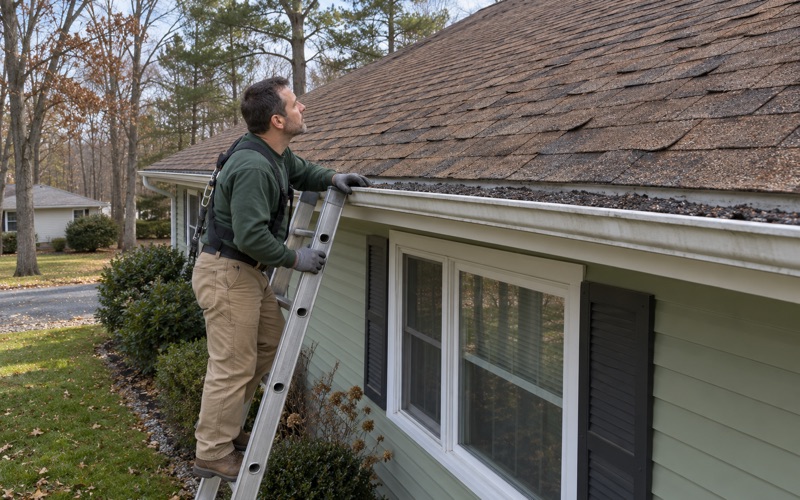
Gutters packed with leaves or pine needles give that ice a head start, because water pools in them and freezes in place. Icicles hanging from the gutter line are the visible sign, but the dam itself sits on the shingles above. We size and pitch gutters with the roof and keep them clear so they drain rather than hold water.
Water Pushed Uphill Under the Shingles
Shingles are built to shed water running downhill. They overlap like scales and depend on gravity, and they are not sealed against water standing on them. Once an ice ridge forms at the eave, fresh meltwater pools behind it, rises up the slope and works its way under the shingle tabs, past the nails and onto the deck.
From there it follows the easiest path: into the soffit, down the inside of the wall or across the top plate into the ceiling below. That is why ice dam damage so often appears a few feet in from an outside wall rather than near the roof’s peak. Fixing the ice alone does not fix the cause, which is usually heat and ventilation.
An Ice Barrier the Code Leaves Optional Here
Why Burlington County Is Off the Map
New Jersey’s building code ties an ice barrier at the eaves to climate. The trigger is a January average temperature of 25 degrees or less, and Sussex County is the only county that meets it. Burlington County, Southampton included, is not on that map, so nothing in the code obliges an installer here to put ice protection along the roof edge.
The result is that two Southampton houses on the same street can have very different eaves underneath the shingles. One installer may have run self-adhering membrane up from the drip edge as a matter of habit, while another laid felt or synthetic underlayment to the edge and nothing more. From the driveway the two roofs look identical.
What Ice-and-Water Underlayment Does
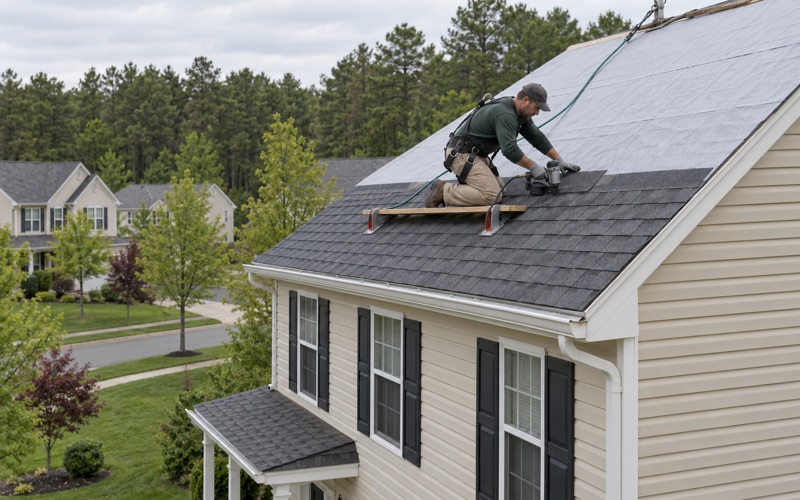
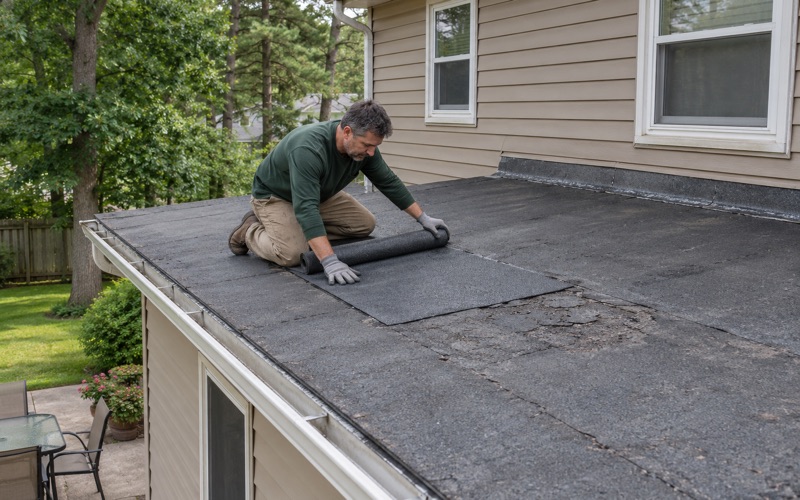
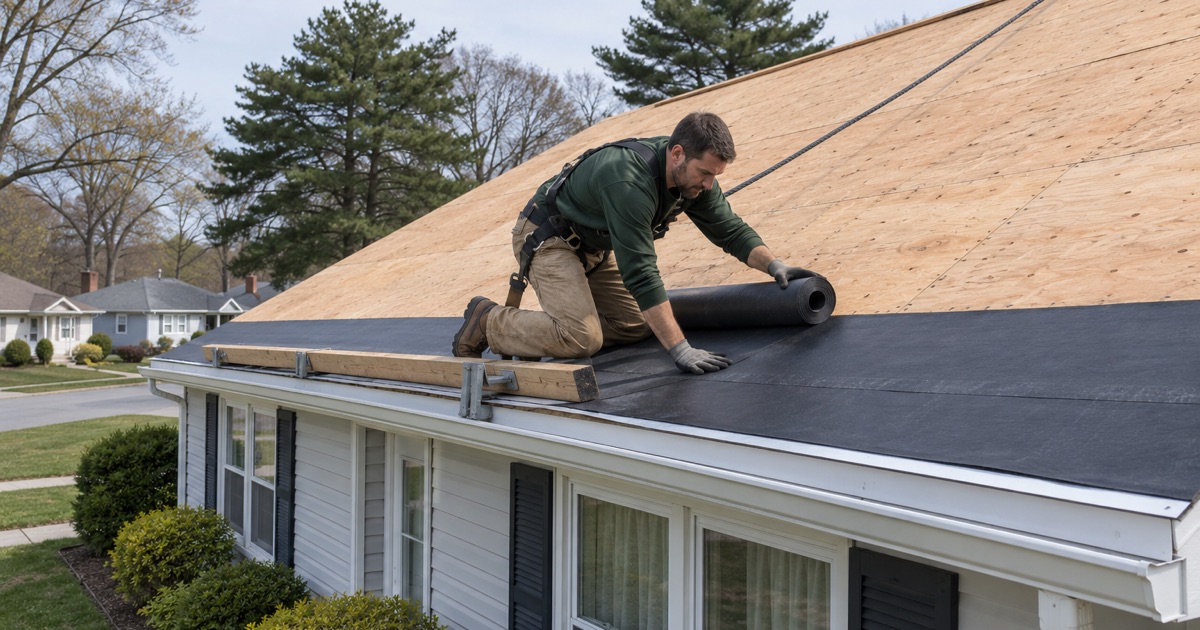
Ice-and-water underlayment is a self-adhering rubberized membrane, made to ASTM D1970, that bonds to the roof deck and seals around every nail driven through it. Where an ordinary underlayment lets ponded water find the nail holes, this membrane closes them. Run from the eave edge to a point past the inside line of the exterior wall, it covers the zone an ice dam floods.
On a Southampton re-roof we treat eave membrane as a line item worth discussing even though the code does not call for it here. Our written scope lists underlayment separately from tear-off, decking, flashing, ventilation and gutters, so an owner comparing two estimates can see whether one includes ice protection at the eaves and the other quietly leaves it out.
Attic Heat in Southampton’s 1970s Houses
The township’s housing leans heavily on one decade. Census estimates count 1,693 of Southampton’s 4,680 housing units as built between 1970 and 1979, more than any other period. Houses of that age were framed before today’s expectations for attic air sealing, and any one of them may have had insulation added or ceilings opened over the years in ways that changed how the attic breathes.
Blocked soffit vents, insulation stuffed against the roof deck and a bathroom fan that dumps into the attic all trap heat and moisture where it melts snow. We check attic ventilation on every replacement, balancing soffit intake against ridge vent exhaust, because a cold, well-vented deck is what keeps snow from melting at its base in the first place.
What to Check on a Roof After a Big Snow
Start From the Ground
Once the snow is off, a walk around the house tells an owner a lot without a ladder. Look for shingles along the lower edge that sit lifted or curled, gutters pulled away from the fascia or bent by the weight of ice, and stains on the soffit boards. Peeling paint just under the eaves is another sign that water has been inside the overhang.
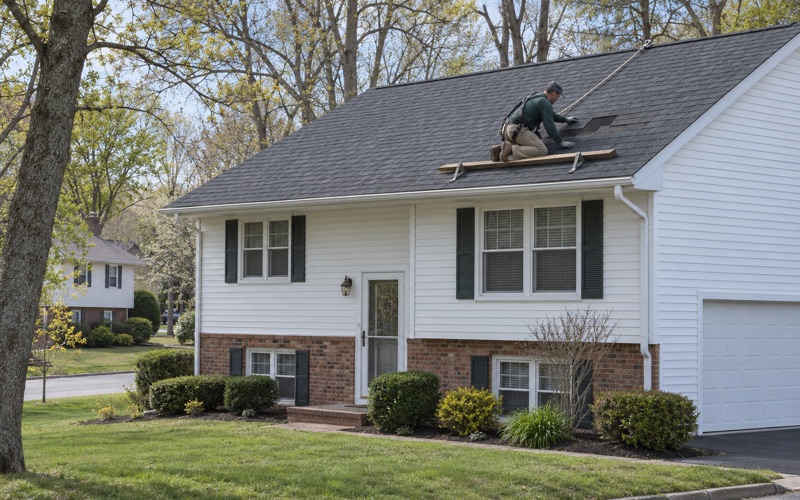
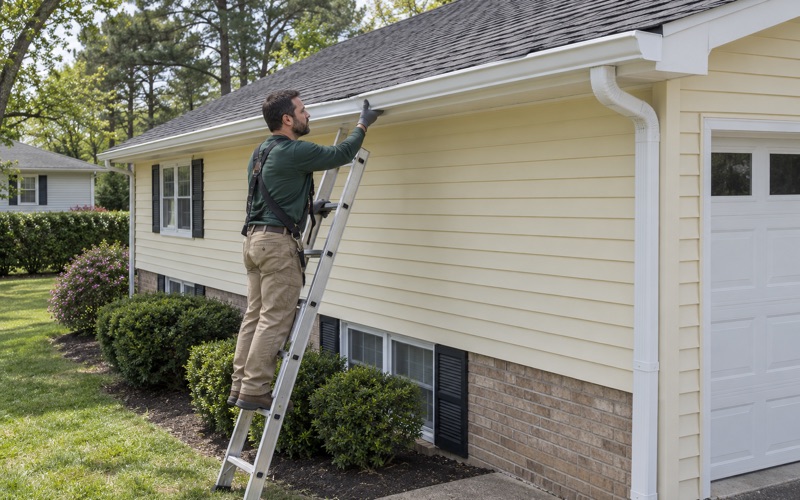
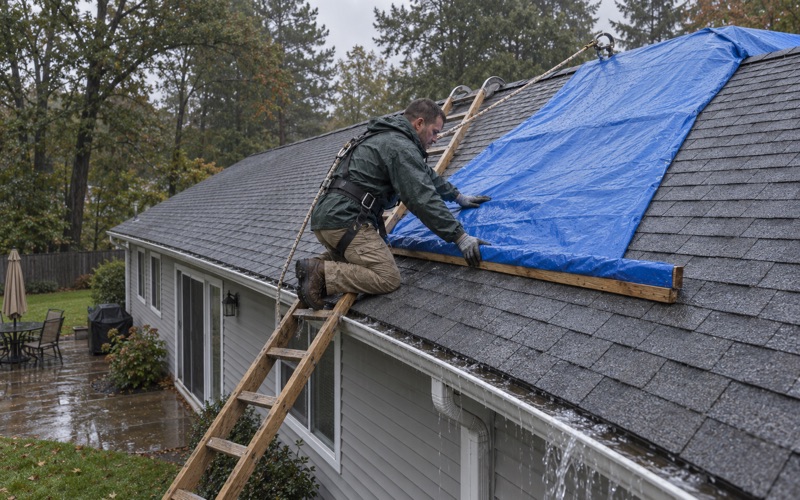
Please do not climb onto a snowy or icy roof, and do not chip at ice with a hammer or shovel. Hacking at a dam tears shingles and punctures the membrane beneath them, turning a seasonal problem into a permanent hole. Our crews work under fall protection at heights of six feet or more, and a slick slope is no place to work without it.
Look Inside the Attic
The attic is where an ice dam leak leaves its clearest evidence. With a flashlight, check the underside of the roof deck near the eaves for dark staining, damp or swollen sheathing and rusty nail tips, and feel the insulation along the outside walls for wet or matted spots. Frost on nails during a cold snap points to warm, moist air reaching the deck.
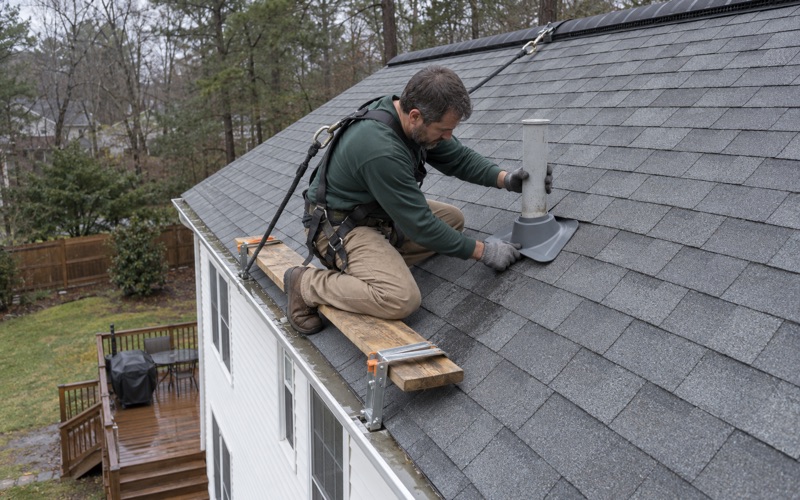
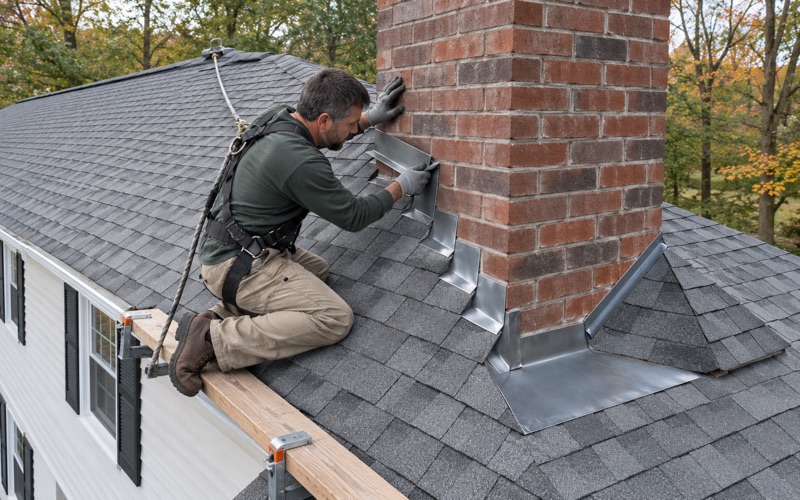
When we answer a leak call after heavy snow, that same attic look comes first, before anyone sets a ladder against the gutter. It lets us separate an eave problem from a flashing leak at a chimney or a cracked pipe boot, which can show up during a thaw and look much the same from inside the room.
Repair Now, Plan the Re-Roof
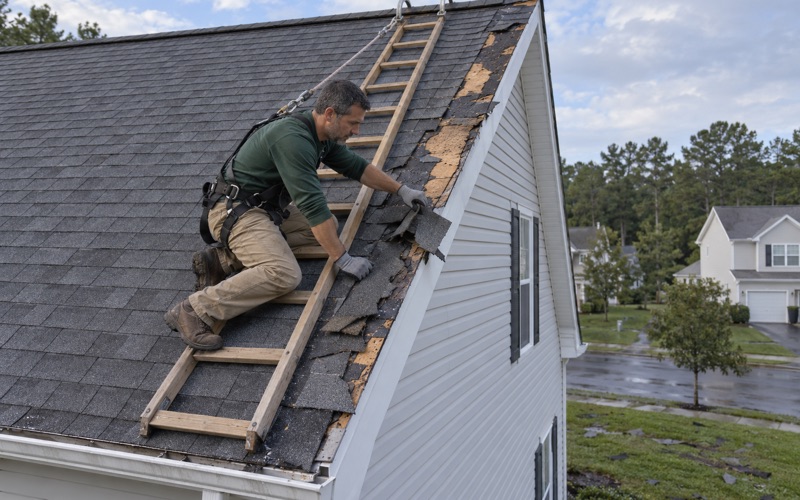
Much of the damage snowmelt causes on an otherwise sound roof can be repaired: a run of lifted shingles, a section of wet decking, a gutter that needs rehanging. We tell owners that directly, and we only talk about replacement when the roof is near the end of its life anyway. If storm damage is involved, we photograph it and write it up for the owner’s own insurance claim.
For a 1970s house that is due, the re-roof is the moment to fix the eaves for good. Re-roofing a detached one- or two-family house is ordinary maintenance under N.J.A.C. 5:23-2.7, so the decisions are the owner’s and the installer’s: ice-and-water membrane at the edge, a new drip edge, corrected attic ventilation and any rotted decking, which we photograph and show before replacing at the per-sheet price in the contract.
- 20+ Years in Business
- Free Written Estimates
- Attic Checked on Every Leak Call