Jackson Elite Roofing provides storm damage roof repair in Jackson, NJ, serving surrounding cities including Vista Center, Cedar Glen West, Leisure Knoll, Leisure Village West and Plumsted. After more than 20 years of storm seasons, we have learned that the most useful thing we can give a homeowner after a storm is an honest assessment: what the storm actually damaged, what was already worn, and what it will take to put the roof right.
We photograph and write up the damage for your own claim, keeping storm damage clearly separate from ordinary wear. When you ask, we meet your insurance adjuster on the roof to show what we found, while the claim itself remains between you and your insurer.
Then we repair the roof properly, on a written, itemized scope. If the damage is limited, that means a targeted repair; if it is widespread, we explain why a larger repair or replacement makes sense.
Recognizing Storm Damage on a Roof
Wind Damage to Shingles
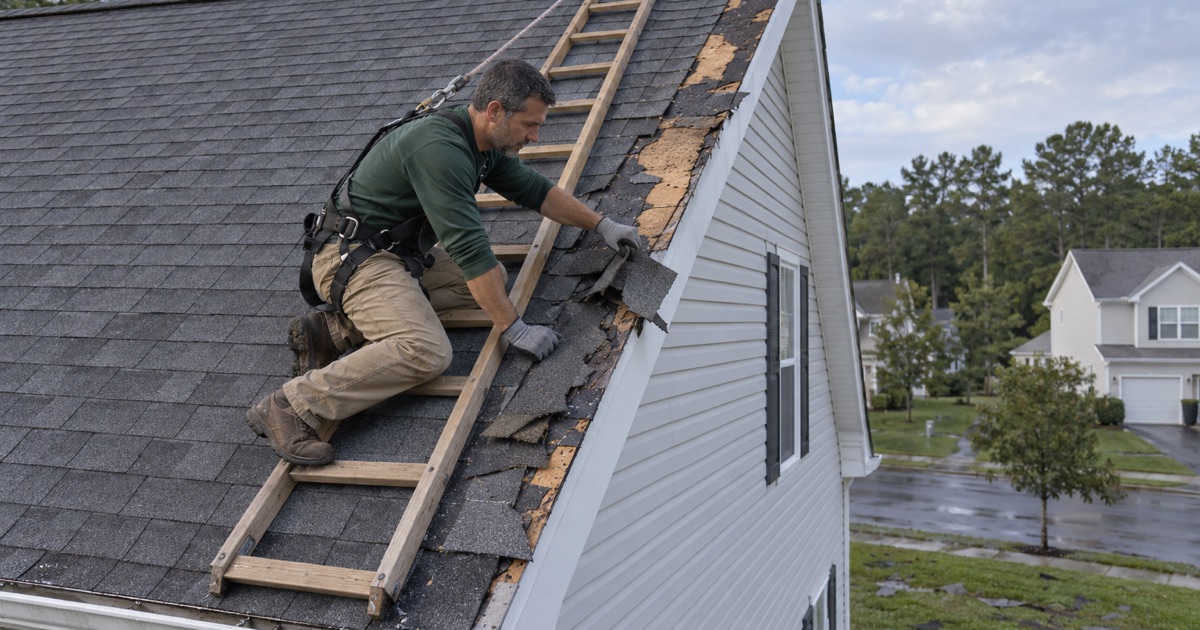
Strong gusts lift shingles, break the sealant strip that holds each tab down and crease the shingle where it bends. A creased shingle may lie back down and look fine from the ground, but it has lost its seal and will tear off or leak in the next storm. Fully missing shingles, exposed underlayment and shingles found in the yard are the obvious signs; the creased ones need a closer look on the roof.
Limb and Debris Impacts
Jackson’s tall pines and oaks mean that falling limbs cause a large share of storm damage here. A limb can puncture the roof, crack decking without breaking through, damage gutters and knock flashing loose. Smaller debris carried by wind can scrape away granules and tear shingle edges. We check the decking from the attic wherever a limb has struck, because damage underneath is often worse than it looks on the surface.
Hail and Flashing Damage
Hail bruises shingles by knocking off granules and fracturing the mat underneath, often leaving soft spots and dark marks. It also dents gutters, vents, flashing and metal trim, which helps confirm a hail event. Wind-driven rain can loosen flashing at chimneys, walls and skylights, and we check every one of those joints after a significant storm.
Storms That Have Hit Jackson
Tornadoes and Severe Thunderstorms
On April 1, 2023, two EF-2 tornadoes crossed Jackson Township, one estimated at 130 mph, and local schools closed the following Monday for tree damage while a number of roofs were badly damaged. Severe thunderstorms bring the same kind of damage on a smaller scale: downed limbs, missing shingles and lifted flashing. After storms like these, we inspect the whole roof, not only the spot where the limb landed.
Nor’easters and Coastal Storms
Nor’easters bring long periods of strong wind and heavy rain, which test every seal and flashing joint on a roof. In September 2026 the state declared an emergency for a nor’easter affecting Ocean, Monmouth, Burlington and Middlesex counties among others. Long-duration wind is especially hard on roofs whose shingle seals were already weakened by age or heat.
Hurricanes and the Hurricane Deductible
New Jersey allows insurers to use a separate hurricane deductible, typically two to five percent of the insured value according to the state, and N.J.A.C. 11:2-42.9 permits mandatory deductibles up to five percent and optional ones up to ten percent in designated areas. Under DOBI Bulletin 11-16 it applies only to a hurricane named by the National Weather Service with sustained winds of 74 mph or more in New Jersey. That is why it was barred for Sandy, which was post-tropical at landfall.
Insurance Claims After Storm Damage
Documenting the Damage
Good documentation is the foundation of a storm claim. We take dated photographs of each damaged area, the overall roof and any interior damage, and write up what we found and where. We note storm damage separately from wear and tear, because a claim that mixes the two invites questions from the insurer.
Wear and Tear Versus Storm Damage
Homeowners policies generally cover sudden damage from a storm, not the gradual aging of a roof. Curling shingles, granule loss across the roof and old repairs are wear; fresh creases, missing tabs, punctures and dented metal point to a storm. Being clear about the difference makes your claim stronger and avoids disputes over items that were never storm damage.
Meeting the Adjuster
When you ask, we meet your insurance adjuster on site and walk the roof with them, pointing out the damage we documented. We answer technical questions about the roof’s construction and what a proper repair involves. Negotiating the settlement is not our role in New Jersey; that belongs to you or a public adjuster licensed under N.J.S.A. 17:22B.
Repairing the Roof After a Storm
Targeted Repairs and Matching
When damage is limited to a few areas, we replace the damaged shingles, flashing and decking, matching the existing roof as closely as possible. With older or discontinued shingles, an exact match may not be possible, and we tell you how the repair will look before we start.
When Storm Damage Means Replacement
If damage is spread across several slopes, or the shingles are too brittle to repair without breaking neighboring pieces, replacement may be the sensible answer. That is also a good time to consider impact-rated UL 2218 Class 4 shingles and high wind ratings, which some insurers reward with lower premiums. Our replacement scope is itemized, so you and your insurer can see each part of the job.
Storm Chasers and Your Contract
After big storms, out-of-area crews often knock on doors promising a free roof. Take your time, check the contractor’s New Jersey home improvement registration and insurance, and remember that home improvement contracts carry a three-business-day cancellation right. Our contracts include that notice in writing.
- 20+ Years in Business
- Free Written Estimates
- Attic Checked on Every Leak Call