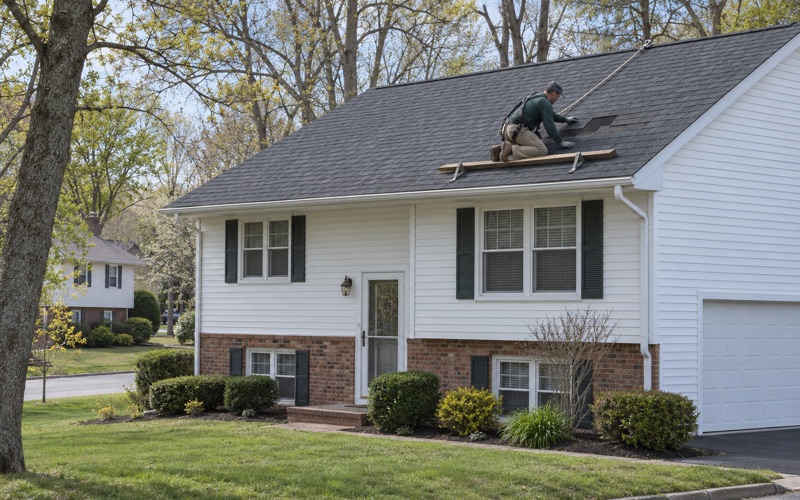
Jackson Elite Roofing brings more than 20 years of work to roofing in Vista Center, and lately one question comes up on almost every visit: is the original roof ready to come off, or does it have a few more seasons in it? We give a straight answer on repair first. If a handful of shingles and a new pipe boot will carry the roof, that is what you hear before anyone mentions replacement.
When the call is about a leak, we go into the attic as well as onto the roof. Water rarely drips where it enters, so we trace the stain on the sheathing back to the flashing, nail line or vent where it actually gets in. Only then do we price anything, because a repair aimed at the wrong spot is money spent twice.
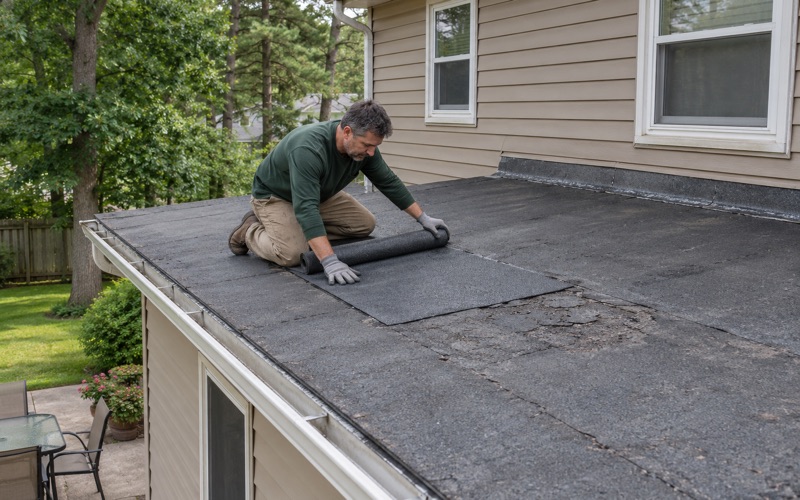
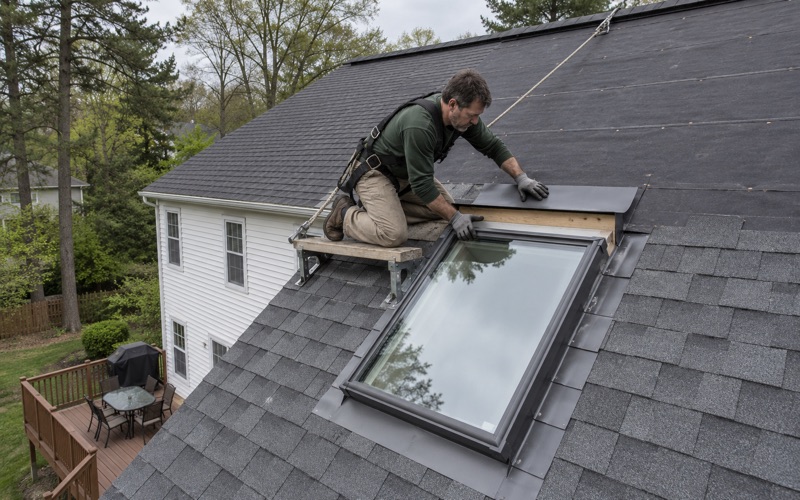
If replacement is the honest answer, our written scope lists tear-off, decking, underlayment, flashing, ventilation and gutters as separate lines. That lets you set our estimate beside anyone else’s and compare item by item instead of guessing what a single lump-sum number includes or leaves out.
A Neighborhood Built in One Decade, Reaching Its First Re-Roof
What the census counts show
Vista Center is a census-designated place inside Jackson Township in Ocean County, and its housing went up fast. The 2000 census counted 173 housing units there; the 2010 census counted 948. The Census Bureau’s American Community Survey dates 692 of the area’s 1,033 homes to 2000 through 2009, and every one of those 1,033 is a detached house.
Owners occupy 995 of the 1,020 occupied homes, so nearly every house here is lived in by the person who owns it. For roofing, that compressed build window matters more than any single number. A neighborhood that went up in one decade does not wear out gradually, house by house. Its roofs reach the same stage of life within a few years of each other.
Four Seasons at Metedeconk Lakes at 17 to 24 years
Most of that growth is Four Seasons at Metedeconk Lakes, the gated, age-restricted K. Hovnanian community of about 778 single-family homes. Construction began in 2002, and the community description puts its completion in 2008. The homes are mostly single-level, some with lofts, and most have two-car garages, so the roof planes are broad and the garage roofs add their own valleys.
Run the arithmetic from those build dates and the original asphalt roofs are now roughly 17 to 24 years old. That is the age range when many first-generation asphalt roofs come up for their first replacement. It is a calculation, not an inspection, so it tells you when to start looking closely, not that any particular roof has reached the end.
Not every house is on the same clock
Vista Center is not only Four Seasons. The same survey counts 142 homes built in the 1970s, a smaller group from the 1950s and 1960s, and 135 built between 2010 and 2019. A 1970s house may already be on its second or third roof, and a 2012 house may have years left on its original shingles.
That spread is why we start every estimate by asking when the house was built and whether the roof has ever been replaced. Mailing addresses here read Jackson 08527, so the address alone does not tell us which group a home belongs to. The roof itself, and the attic underneath it, tell us the rest.
Looking for roofing closer to Cedar Glen West? See Roofing Services in Cedar Glen West.
Signs a First-Generation Shingle Roof Is Near the End
Granules in the gutters and bare patches
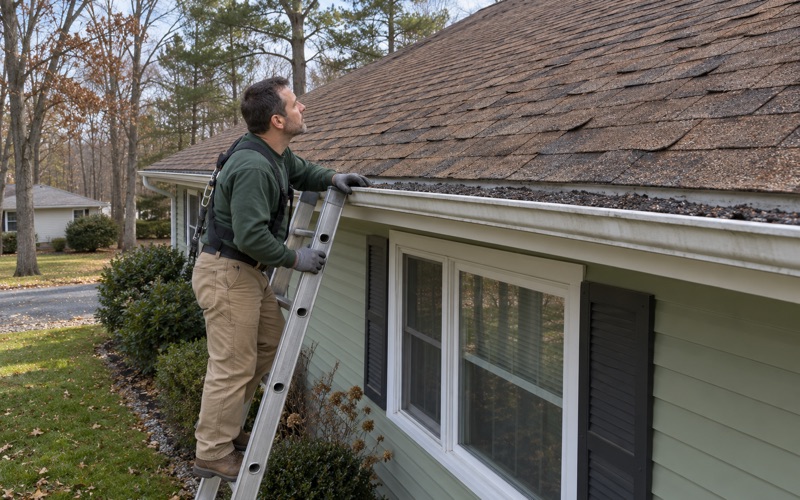
Asphalt shingles shed their mineral granules slowly through their working life, and faster near the end. If the gutters and leaders hold a layer of dark grit after a rain, or the shingles on the sunniest slope look smooth and dark in patches, the asphalt underneath is losing its protection. The south- and west-facing planes usually show it first.
Granule loss on its own does not mean the roof leaks today. It means the shingles are becoming brittle and will crack more easily in cold weather and wind. We note where the loss is heaviest, compare it with the shaded slopes, and tell you whether the roof is a candidate for repair or is better planned for replacement in the next few years.
Curling, cupping and lifted tabs
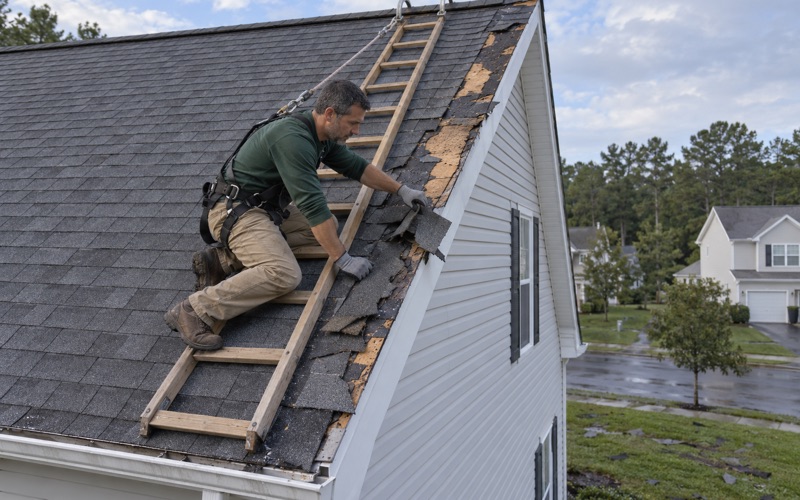
Shingles whose edges curl upward or whose middles cup downward have lost their flexibility. So have tabs that lift in a strong wind and do not lie flat again. Once the sealant strip lets go, wind can get under the shingle and fold it back, and a single storm can strip several courses from an older roof in one afternoon.
A few lifted tabs can be sealed or replaced. When we find them spread across every slope, patching becomes a cycle of service calls, and the better spend is a full replacement with architectural shingles rated for wind, such as ASTM D3161 Class F or ASTM D7158 Class H, over a new synthetic underlayment.
Flashing, pipe boots and the attic side
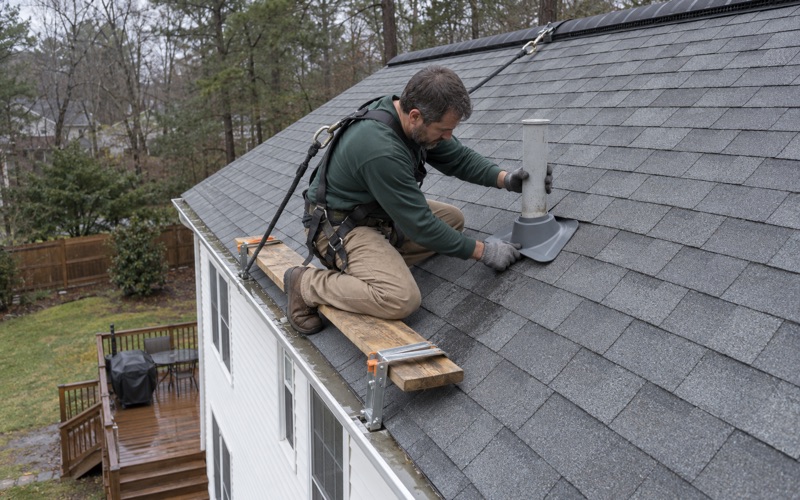
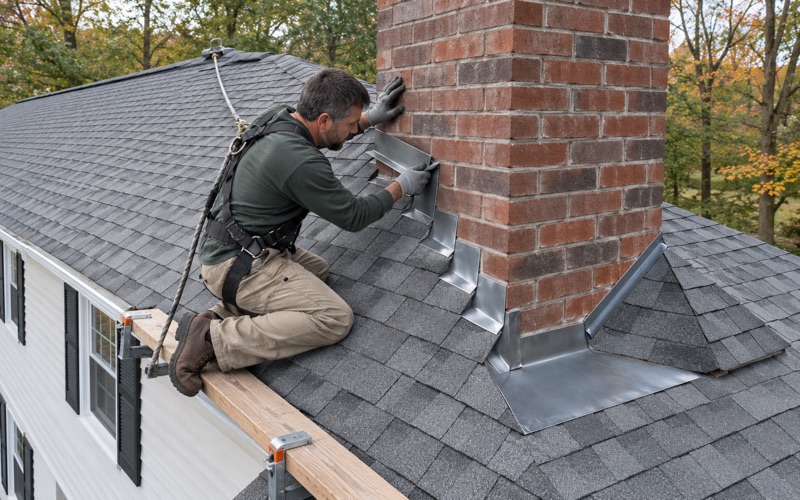
On many roofs of this age, the first leak is not through a shingle at all. Rubber pipe boots crack in the sun and let water run down the vent pipe, while step flashing along a wall or the garage tie-in can shift. Those are repairable on their own, and we will tell you so when that is the whole problem.
Inside the attic, we look for stained sheathing around nails, frost or damp insulation in winter, and soft decking near the eaves. A roof that cannot breathe ages from underneath, so we check the ridge vent and soffit intake on every replacement and correct the balance rather than repeating whatever was installed originally.
When Neighbors’ Roofs Come Due in the Same Few Years
Why roofs of the same age wear together
When hundreds of houses go up within a few years using similar materials, their roofs face the same sun, the same wind and the same winters on nearly the same schedule. Vista Center falls in the National Weather Service’s Ocean forecast zone, handled by the Mount Holly office, so one storm warning covers the whole neighborhood at once.
The practical result is that roofs here tend to come due in clusters. If the house across the street just had its roof replaced, yours is likely of a similar age and worth an inspection, even with no leak yet. That is not a sign anything is wrong. It simply means the next few years are the window to plan in, rather than react to.
Planning a replacement instead of reacting to one
When many owners need the same work in the same years, the ones who plan ahead get their choice of schedule and material. We would rather inspect a roof a season early and tell you it has time left than meet you the morning after a storm with water already in the ceiling and every crew in the area booked.
If you are comparing estimates, look first at decking, underlayment and flashing, the lines where two quotes most often differ. Ask every contractor whether the old flashing will be replaced or reused. We replace step, counter and chimney flashing with the roof rather than tucking new shingles against twenty-year-old metal.
What the tear-off can reveal
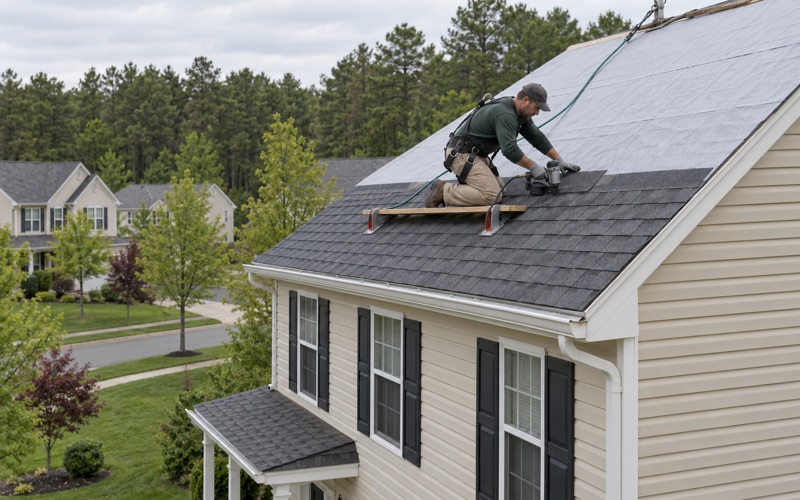
The first replacement on a 2000s house is usually a single-layer tear-off, which keeps the job clean and lets us see the decking. Most of it is sound, but soft sheets turn up around old leaks, plumbing vents and the low edges of valleys, and nobody can see them until the shingles come off.
When we find damaged decking, we photograph it and show you before replacing anything, at a per-sheet price already written into the contract. You are never handed a surprise total at the end. At the close of each work day, we clean the driveway, yard and gutters and run a magnet sweep for roofing nails.
The Association Fee List and Questions to Ask Before Re-Roofing
What one listing’s fee covered
A 2012-built home at 4 Lenox Road in Four Seasons at Metedeconk Lakes was listed with a shingle roof and an association fee of $339. The listing said the fee covered lawn maintenance, the pool, snow removal, trash, common areas, management fees and the recreation facility. Roofs did not appear on that list.
That is one listing, not the community’s governing documents, so it settles nothing on its own. It is easy to read a fee list either way, as proof the roofs are covered or proof they are not, and the only reliable answer is in the documents themselves.
Check the documents before the estimate
In 55+ and other planned communities, we check who holds the roof against the association’s own documents before we write an estimate. Ask the management office for the declaration and any architectural guidelines, and read what they say about roof replacement, approved materials and colors, and any approval steps that come before work begins.
If the documents leave the roof with the owner, we write the scope to whatever material or color standard they set. If they assign any part of it elsewhere, you will know before you sign anything. Either way, the question gets answered on paper first, not on the driveway once the dumpster arrives.
Permits and the contract on a detached house
Under New Jersey’s Uniform Construction Code, replacing the roof covering on a detached one- or two-family house is ordinary maintenance that needs no construction permit, under N.J.A.C. 5:23-2.7. Work beyond the covering, such as structural framing changes, is a separate matter for the Jackson Township construction office.
Our contracts follow New Jersey’s home improvement rules, including the three-business-day cancellation notice. If you plan to sell, we can also provide a written roof condition report to hand to the buyer’s inspector, describing the roof’s age, condition and any repairs we made, so the roof is not left as an open question at closing.
- 20+ Years in Business
- Free Written Estimates
- Attic Checked on Every Leak Call